


Volvo Penta enters larger workboat market
When the first of Northern Offshore Services’ new 34m CTVs hits the water later this year, it will also be demonstrating Volvo Penta’s latest technology.
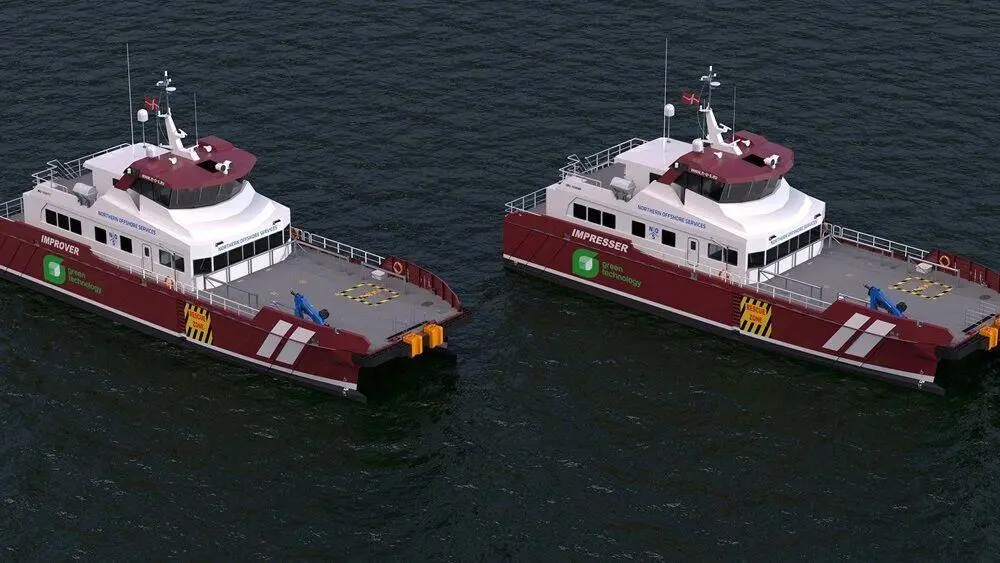
“Both I-Class vessels that we currently have in production are being fitted with the Volvo Penta IPS Professional Platform,” says Northern Offshore Group CEO David Kristensson.
The reason is straightforward but noteworthy: while ‘integration’ has long been Volvo Penta’s buzzword, the new platform promises to tie together a range of energy sources. This in turn has the potential to lift Volvo Penta’s offering into the larger commercial sphere.
Put simply, it works by enabling and managing multiple power inputs to cover everything from clean running combustion engines to hybrid and battery solutions.
Volvo Penta’s platform allows the vessels to operate in part or fully electric mode during transit and docking manoeuvres.
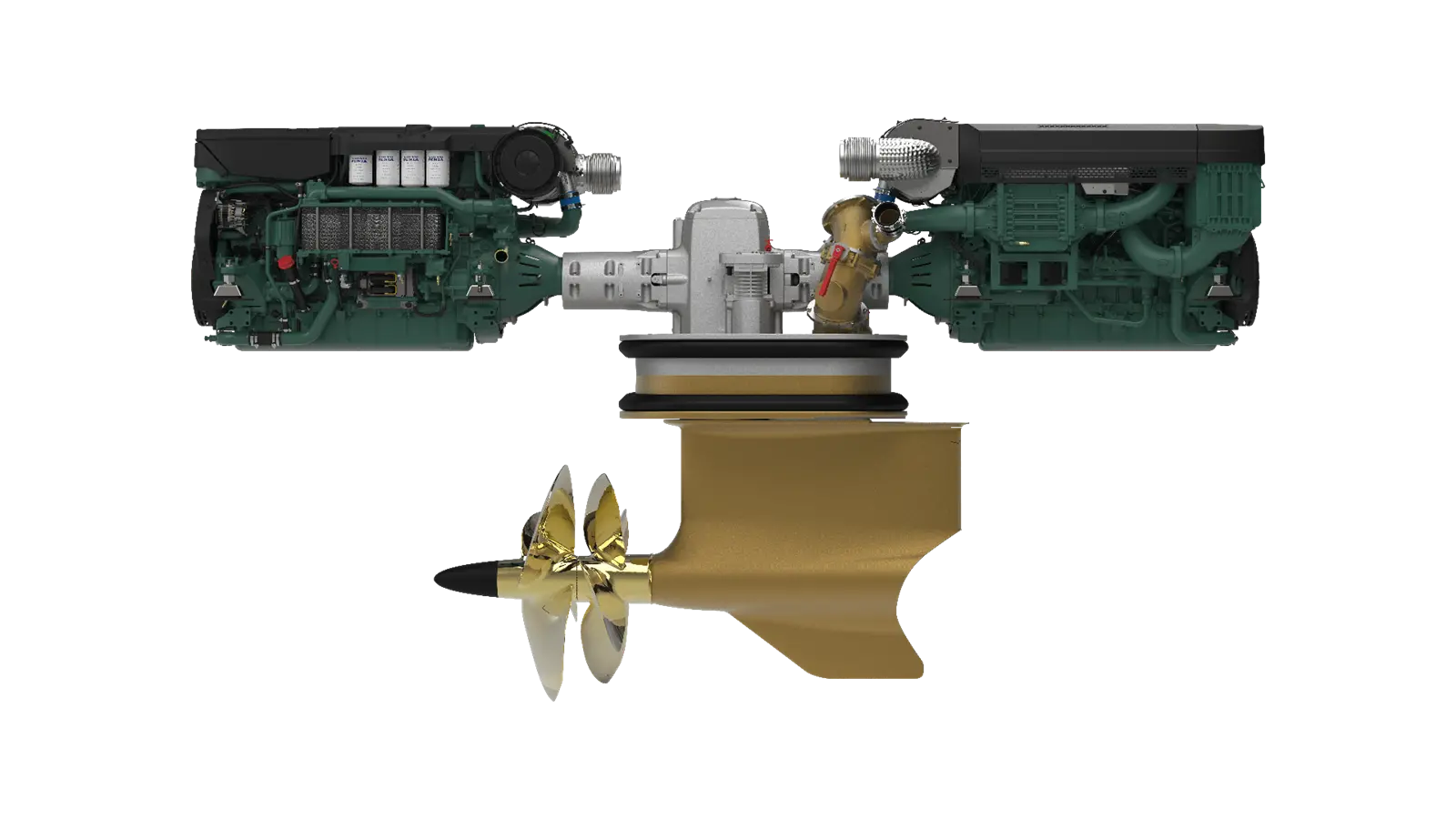
“The N-O-S vessels have two propulsion units – IPS 40 drives – and four combustion engines; two per drive,” says Jan-Willem Vissers, Volvo Penta’s commercial marine director. These CTVs will initially aim at operating on low-emission fuel, but changing the mix is fairly straightforward.
“The engines can be upgraded or replaced by electric motors in the future,” he says. “This is the next step in a long-term partnership that we have held with Northern Offshore Services over the last 16 years. We are grateful for the collaboration so far which has now led to the integration of the Volvo Penta IPS Professional Platform on an impressive line of Northern Offshore Services I-Class vessels.”
According to Volvo Penta, the technology should also yield fuel savings of up to 30%.
This is largely supported by the platform’s Eco Mode, which bases the ship’s energy use on real-time requirements, raising efficiency by reducing fuel consumption across a large swathe of the drive cycle.
Altogether, it makes a very appealing choice for CTVs with their typically broad operating profile.
“It’s a flexible engine configuration that only draws the power it needs and adapts to whatever situation it’s in,” says Kristensson.
Cockpit features
Although the onboard management is capable of automatically starting and stopping individual engines or energy feeds, the helm is still able to keep an eye on it through the company’s ‘Glass Cockpit’, which provides a full overview and control of engine data, navigation and so on.
Smart features such as Assisted Docking and Dynamic Positioning are also tied into the display, while beyond the bridge, predictive maintenance, remote diagnostics and remote software downloads all contribute to increased uptime.
The IPS Professional Platform is far from a leap in the dark.
Rather, each element has a solid precedent behind it: for example, integration originally stems from the company’s Electronic Vessel Control technology; the Glass Cockpit and ancillary features emerged a while ago; and the IPS 40 drives come from Volvo Penta’s established line of quiet, low-vibration propulsion systems.
The new dual-input on these new IPS units have allowed the company to push the power up into the useful range for the commercial workboat market. It’s also worth noting that the platform can also handle triple or even quad drivelines, potentially yielding up to 8,000hp/5,880kW.
It may be less dramatic, but the IPS 40 drive has another useful characteristic: like its forbears it’s rather more compact than traditional inboard shaft installations.
Taking advantage of a position far to the rear of the vessel can also mean freeing up much needed internal volume further forward, while dropping vibration and noise levels where it matters.
It’s a package that seems especially suited to N-O-S’ bigger, longer endurance CTVs: the 34m, 11.20m beam I-Class allows a large 131m2 forward deck with an extra 40m2 at the rear, and there’s also room for 32 seats onboard.
The service company has kept innovation central: Kristensson believes it’s key to meeting the evolving energy requirements as well as improving the onboard experience.
These two elements go hand in hand.
“CTVs benefit from new technologies that make the work more efficient and more precise, which in turn could make operations easier, safer and more comfortable for crew and technicians,” he says. “They also hold the potential for more sustainable operations, which is a priority for this transformative industry.”
There’s little doubt that giving CTVs the ability to make use of new energy sources will be crucial for the industry’s growth and sustainability in the potentially demanding years ahead.
Related Articles
 OTHER NEWS
 MARINE CIVILS
 AUTONOMOUS VESSELS & TECHNOLOGY