

Volvo Penta claims world first with E-CTV retrofit
Volvo Penta will replace the diesel engines on a crew transfer vessel (CTV) with fully electric propulsion in a first-of-a-kind retrofit, the company claims.
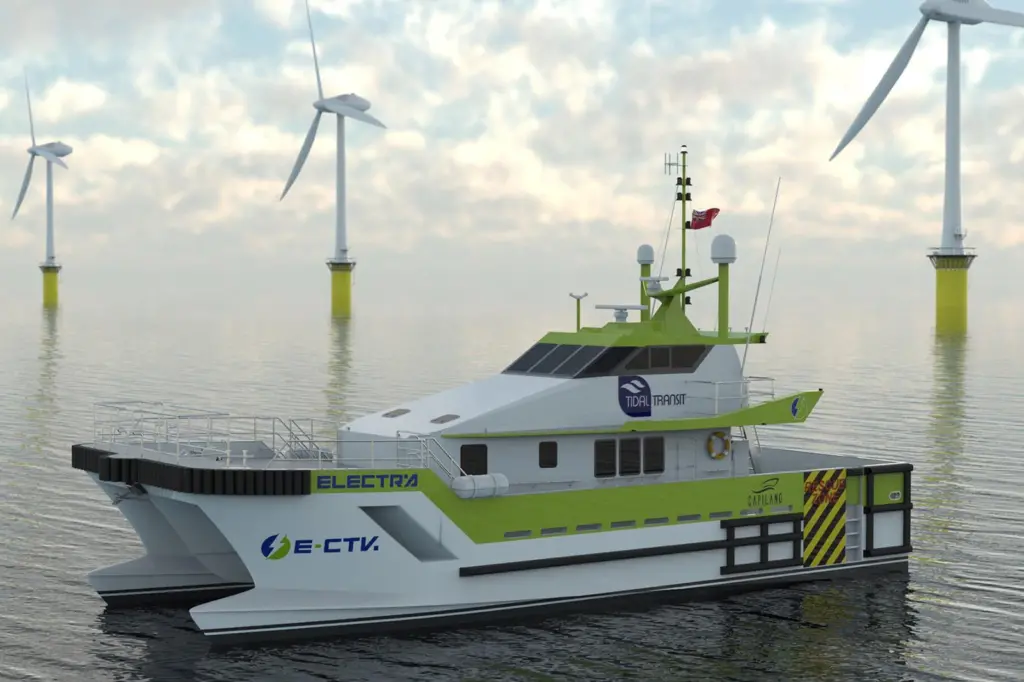
The vessel will be retrofitted with Volvo Penta’s Inboard Propulsion System (IPS) in the UK for crew transit service operator Tidal Transit, which says it is ’working to create the world’s first fleet of multi-functional electric crew transfer vessels’.
The cost of the retrofit is estimated to be £8 million (€9.4 million) and will be mainly funded by the UK government’s ZEVI (Zero-Emissions Vessel & Infrastructure programme).
”Using an existing vessel delivers better circularity and sustainability and helped make the project one of just 10 leading-edge developments awarded UK government funding as part of an industry-led transition to net-zero,” says Volvo Penta.
The Mercurio vessel, owned by Norfolk-based Tidal Transit, will be renamed e-Ginny on completion. The 20m long vessel will be fitted with 2MWh of battery capacity and forward-facing, individually steerable drives with twin counter-rotating propellers.
Tidal Transit is also working on shoreside charging capabilities, which it admits are ‘severely limited’.
“The project will expand vessel charging infrastructure by installing both an onshore charging station from Artemis Technologies and an offshore wind turbine-based charger from MJR Power & Automation,” it says.
Other equipment suppliers include battery developer Corvus Energy and Danfoss.
“We are delighted to be involved with such a landmark project, which will feature our first ever Volvo Penta IPS powered 100% by batteries and with no on-board diesel generators,” said Volvo Penta UK sales manager Mehmet Belibagli. “It’s an ultra-efficient set-up that will deliver longer-range and emissions-free transfers. There’s also closer control and manoeuvrability so journeys are safer, faster and more reliable.
“We believe this is the future for a number of segments within the marine industry and hope it will inspire further projects.”
Related Articles
 OTHER NEWS
 MARINE CIVILS
 AUTONOMOUS VESSELS & TECHNOLOGY