

Speed@Seawork 2024: Sights, sounds and highlights
Seawork’s high-speed vessel trials day marked its fifth anniversary with a diverse selection of commercial marine craft, showcasing a range of propulsion technologies and hull materials, writes Jake Frith.
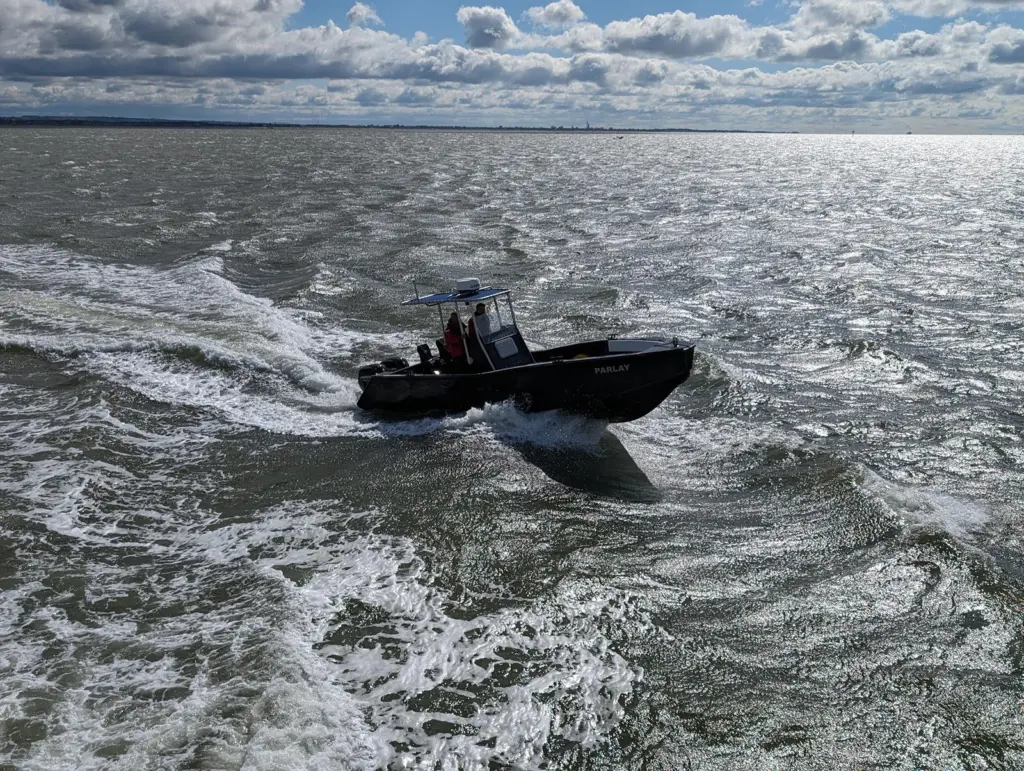
Ten vessels accompanied by a healthy delegation numbered in triple figures made the trip to the historically important Royal Ocean Racing Club at Cowes, where they made their own small bit of history as the first guests to sample RORC’s fresh clubhouse, only handed back days before by the architects after a £ multi-million rebuild and modernisation.
HDPE gathers momentum
Apart from the legendary quality of the cakes on offer during the course of the day, what will stick with this observer about Speed 2024 was the proportion of vessels made from the not particularly new, but super durable boatbuilding material HDPE. Of the 10 vessels on show, three were these characteristically angular HDPE workhorses.
High density polyethylene has been around a while but barely a year goes by without a new HDPE boatbuilder in the commercial sector popping up, or an existing boatbuilder jumping aboard this material.
Cutting to the chase, HDPE workboats are getting better: a lot better; and commercial boat buyers are now taking notice.
Talking to Yossi Moskovitch, CEO of one such boatbuilder- Leemar Group, the material stands up well in comparison with aluminium, hitherto the first choice material for most high-speed workboats.
HDPE boats are welded together with a specific heat gun that melts and feeds a filament of HDPE into the V-shaped gap between the assembled panels. The plastic welding is conducted at much lower temperatures than any metal welding process, and just like a good metal weld, it is every bit as strong as the surrounding material.
This strength was corroborated by all three HDPE boatbuilders at Speed (Tideman Boats, Bulldog Marine and Leemar), none of whom have ever seen a seam fail. The hull panels themselves can be punctured if abused horribly, but these can be easily repaired, even ‘in the field’.
The boats all look quite similar because are all hard chine boats (and at Speed all three had black hulls too). The Bulldog had RIB-like rounded topsides – a clever use of existing HDPE pipeline extrusions made for other industries – but they all rode and handled well and the naval architects are clearly getting to grips with the material, while the builders are learning how to craft useful design additions underneath, such as spray rails.
An average fleet operator can learn to weld HDPE successfully enough to conduct strong, long-lasting repairs in the field in less than one week, Moskovitch says, and the welding equipment is not expensive or sensitive to environmental conditions, unlike aluminium welding.
Underlining the robust nature and in-field serviceability of these craft is the fact that 80% of Tideman Boats and 90% of Leemar Boats are sold onto the African continent.
According to Yossi Moskovitch, traditional RIBS suffer terribly in the heat of Africa with the glues breaking down, sometimes reducing the tubes to a kit of parts within a year.
The lack of port infrastructure also means hull grounding is a more common occurrence, an area where the greatly superior grounding resistance of HDPE over aluminium or GRP really earns its corn.
On the water, all three boats impressed. The material is thicker than aluminium or GRP, and the nature of the construction means you see panels on edge around the boat, and hence notice the thick ‘skins’ of these boats.
This makes them ‘look heavy’, but heavy they are not, and they seem adequately stiff. A panel of HDPE tossed into the sea floats, and these boats perform well. For example, Bulldog Boats’ 7.8m, with an all-up weight of 2400kg, cruised at 20 knots; a typical speed for commercial operations, with its (395kg) 300hp OXE Diesel outboard at a low stress, quiet throttle level, sipping under 27 litres of diesel per hour.
Hybrid dreams – and realities
Simon Barnett, a representative of OXE’s UK distributor Proteum, was at the wheel of the Bulldog, letting slip the next big thing in the pipeline from the Swedish diesel outboard innovators.
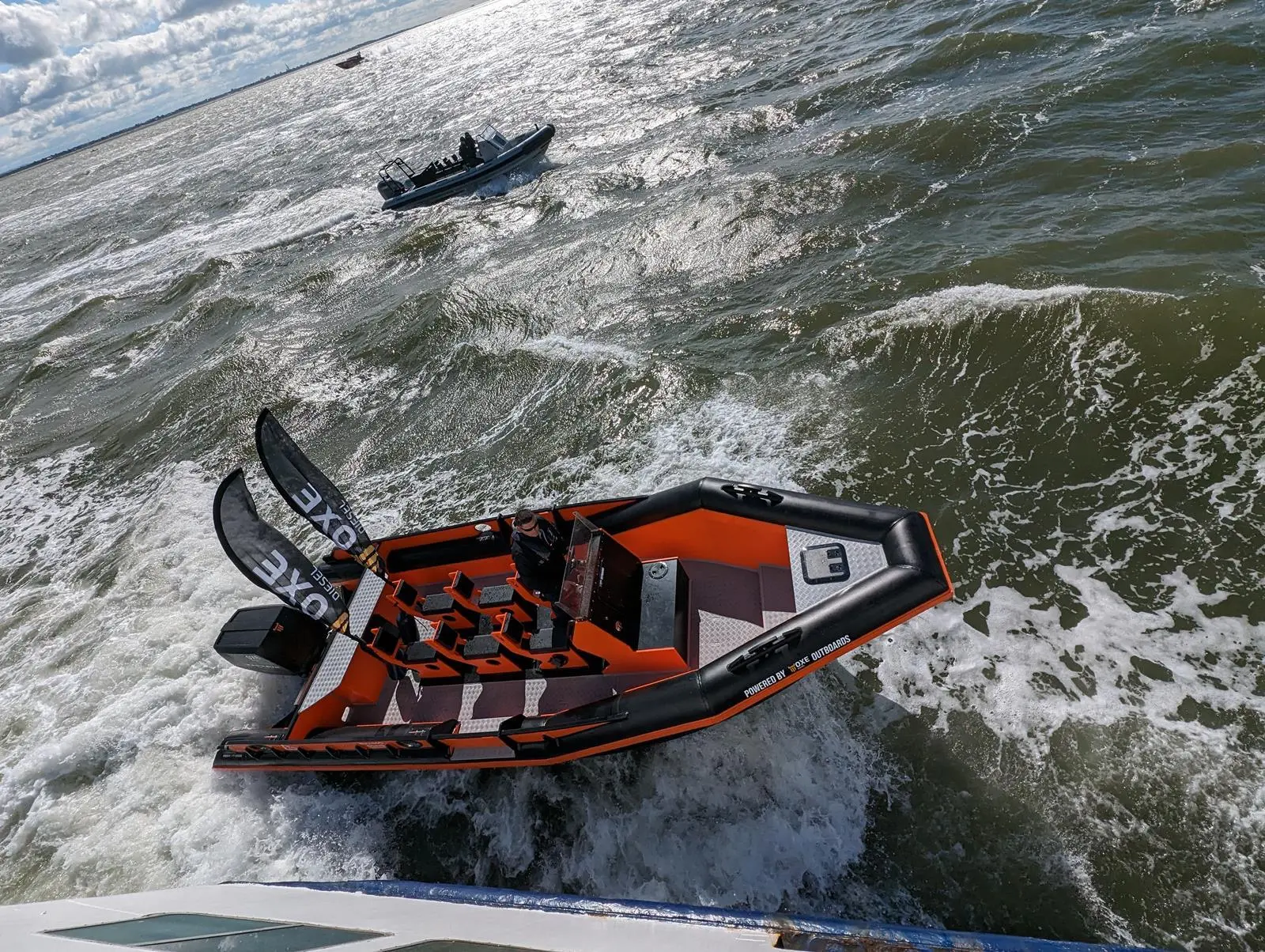
With the addition of a 150hp motor to the OXE 300’s drivetrain, the next move is set to be a 450hp diesel electric hybrid version. The addition of the permanent magnet motor, I believe not much bigger than your kitchen kettle, will result in a small bulge to the lower rear of the cowl (the overall upper dimensions of the cowl look set to remain the same), and the addition at the engine of just 40 extra kgs of weight.
The diesel engine’s existing alternator already puts out enough wallop to charge the propulsion battery pack, Simon said.
Of course, there is the weight of the propulsion battery pack itself to be factored into any calculations, and this will vary wildly according to the user case, but this battery can be placed in many more locations within the boat.
However, the sheer ability to offer 450hp in a single diesel outboard package is likely to be unique in the market and will offer some potential savings on both capex and opex for users who were using twin engines because 300hp (or in the case of OXE’s main competitor’s 350hp) just wasn’t enough to get away with a single engine.
Diesel inboard big hitter Scania has also been hard at work on many things hybrid, the latest fruit of this significant workstream being the largest boat at Speed this year.
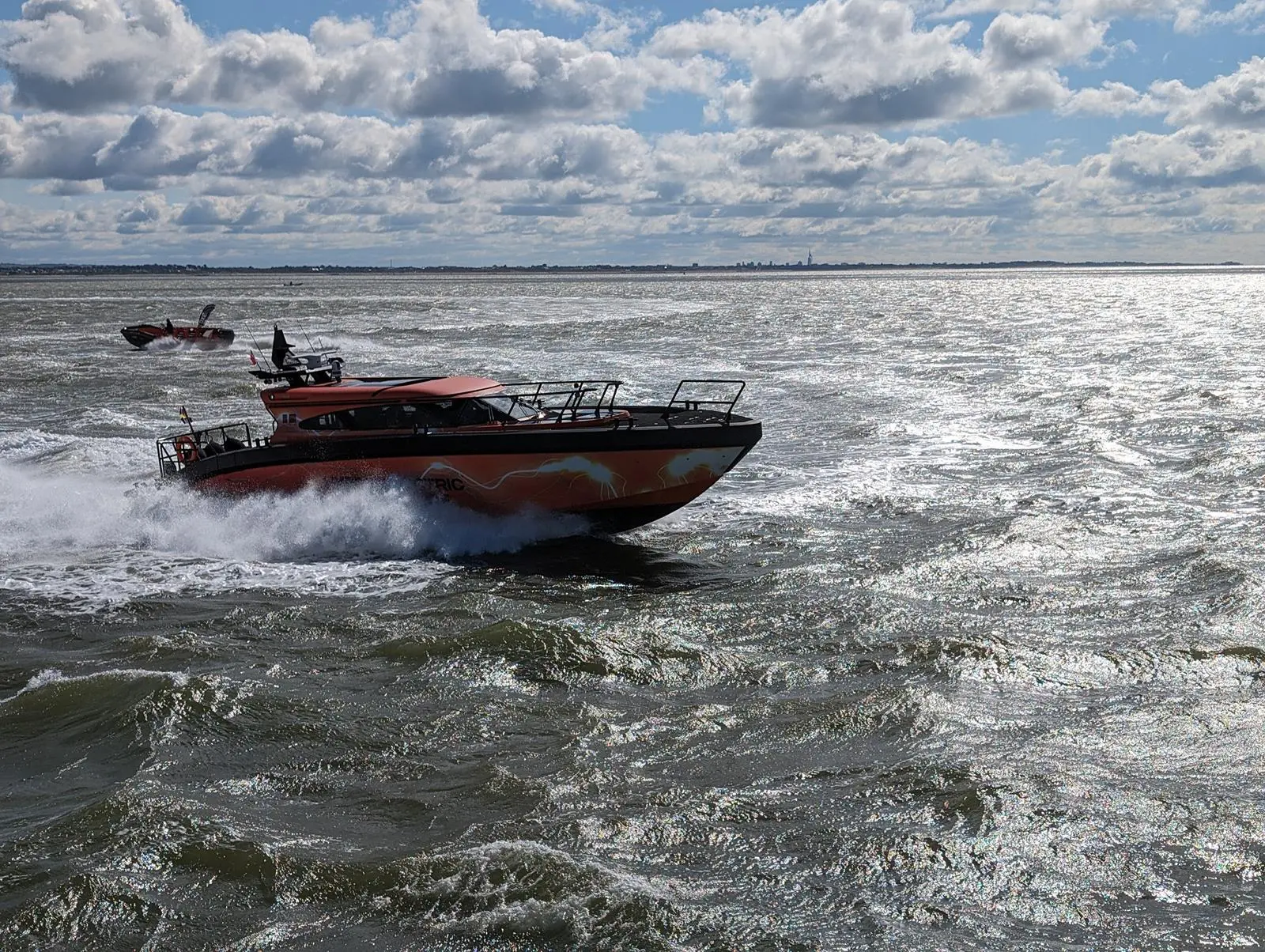
In partnership with Marel boats, Scania presented a Search and Rescue oriented all weather fast rescue cabin launch of stellar performance. The 25 tonne (fully loaded) M17 from Marel made short work of a nasty Solent chop, navigating it at a whisker under 50 knots, but the real ace up its sleeve was the 6 hours at 6 knots that it was able to deliver on pure electric drive from the 312kWh of (available) power from its hefty (4m long by 1m wide by 1m deep) battery pack below the cabin floor.
Its full suite of glass bridge Raymarine instruments, including the latest berth assist and station-keeping functionalities, and plush riding Ullman suspension seats for all crew suggested somewhat higher budgets for Nordic search and rescue organisations than we tend to see over this side of the north Sea.
For those internal combustion propulsion manufacturers who feel a little late to the decarbonisation party, the MV Shockwave from first time Seawork exhibitor Purple Sector might offer one path to leapfrog the competition.
Purple Sector wasn’t there to sell a boat, a propulsion system, or even a particular technology – more to sell the consultancy expertise of the company, which is offering an impressive set of capabilities thanks to a cadre of engineers recruited from Formula 1 and hybrid supercar pioneers such as MacLaren and Mercedes Benz.
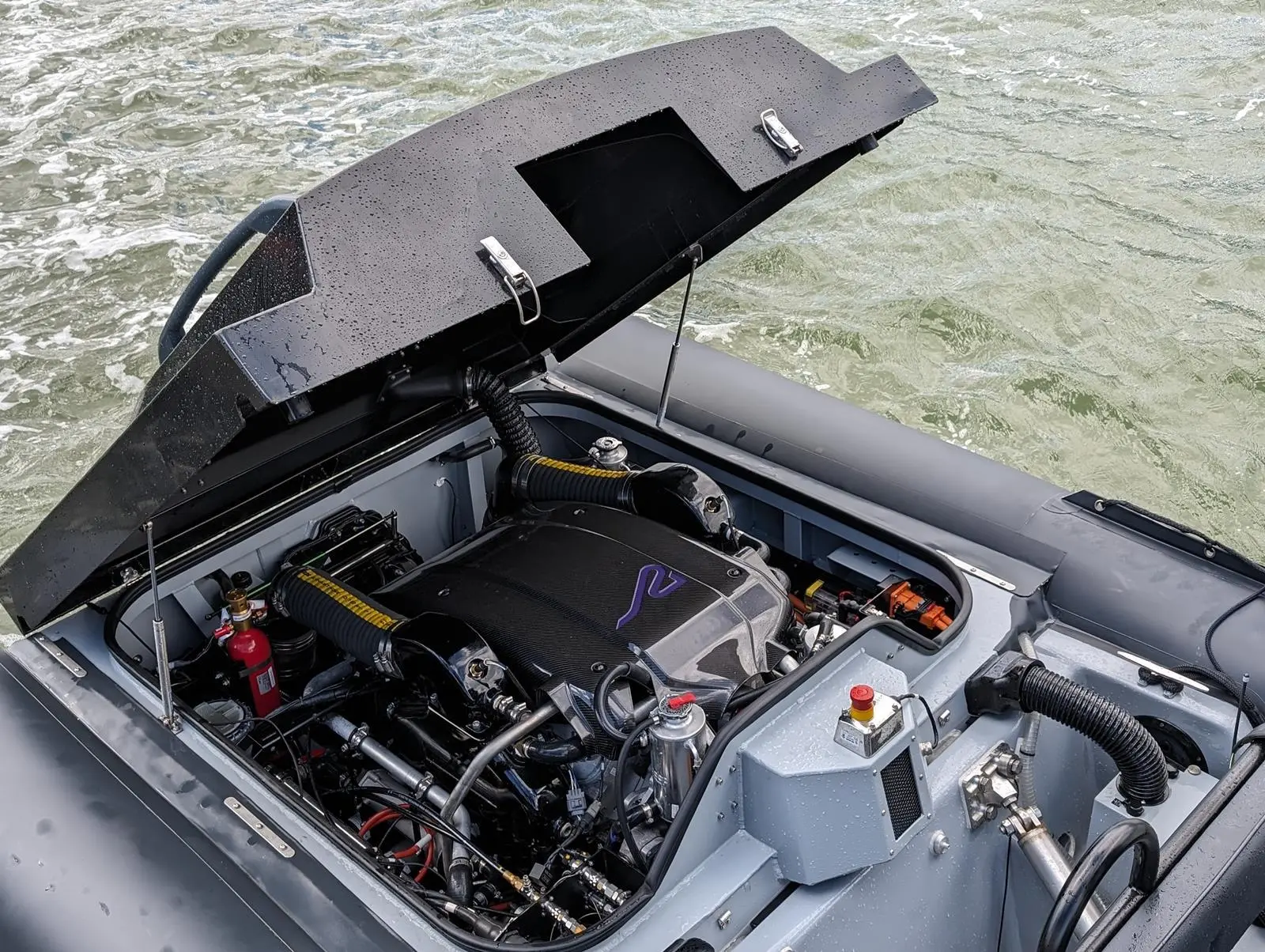
The proof of this pudding was the MV Shockwave at Speed, which started life as a pretty standard Shockwave RIB. In just seven months, Purple Sector prototyped an electric hybrid system with a bespoke, low profile gearbox running a motor and General Motors V8 gasoline engine on flex fuel from 100% methanol to 100% gasoline (and any combination in between).
To do it, they also pioneered a new propulsion configuration called the ‘halfboard’. Nothing to do with package holidays, it’s a section of hull that they added to the transom of the RIB to accommodate the whole propulsion system.
According to Purple Sector’s Design and Development Team Lead Noel Moorhouse, The halfboard approach was a sensible way to prototype the technology because it allowed the whole lot to be simply unbolted and craned on and off the rest of the boat for testing and setup, and was part of the reason the technology was prototyped so quickly.
Testing the boat up the Medina River, the most impressive aspect for me was the management system and the seamless way it switched between one of three power sources (all gasoline, all electric or electric and gasoline), according to power demand or user input. The way the instrument display changed its readout parameters according to the energy source was reminiscent of high-end hybrid cars and, for marine, felt like a glimpse of things to come.
AI-driven marine guidance for safety and economy
The features of Speed 2024 were not limited to the vessels on the water, thanks to some interesting static displays back at RORC HQ. The least static of these was Hefring’s marine guidance system, hooked up to Berthon’s Gemini WR880 RIB, reporting and recording any shocks, accelerations, fuel use and skipper behaviours in real time to a laptop on dry land. According to Hefring’s CEO and Founder Karl Birgir Bjornsson, the system is already showing its mettle in its native Iceland, where it’s been adopted by the national Search and Rescue vessel operator.
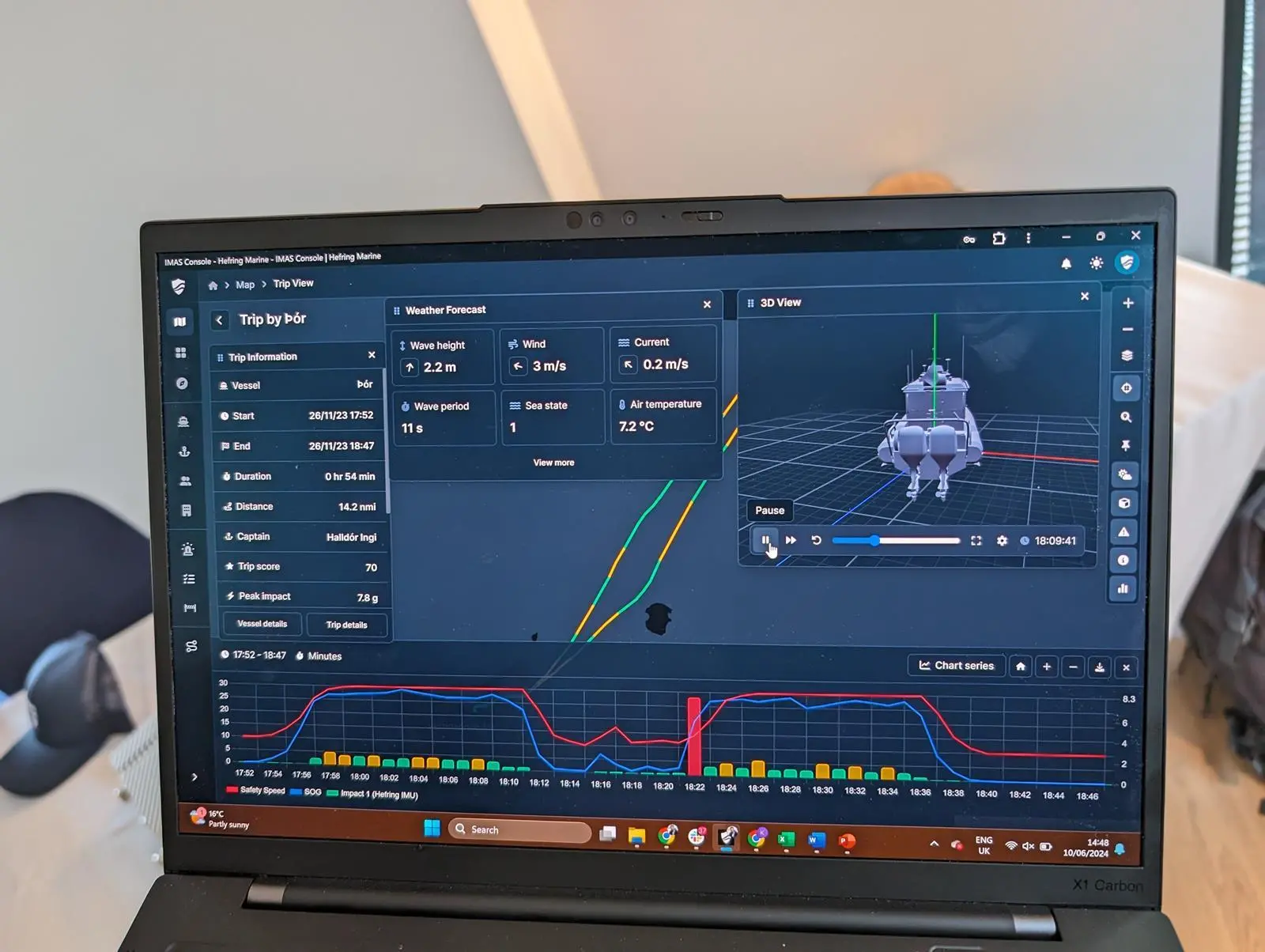
Not only this, it has been embraced by a local marine insurer, who is set to offer enhanced services and in future perhaps even reduced premiums to Hefring adopters.
It’s already being used to cut down on litigation and debate when things go wrong and crew or passengers of fast craft suffer injuries, potentially or arguably due to the vessel not being operated at an appropriate speed.
Beyond this, the Hefring system also aims to help train vessel operators in a more cost-effective manner, along with monitoring and protecting vessel and equipment condition and lowering the operator’s carbon footprint.