

MOL changes tack into offshore wind vessels
As Europe faces a growing lack of availability of offshore wind installation vessels, Japan is making sure it won’t be left in the same situation as its own industry grows.
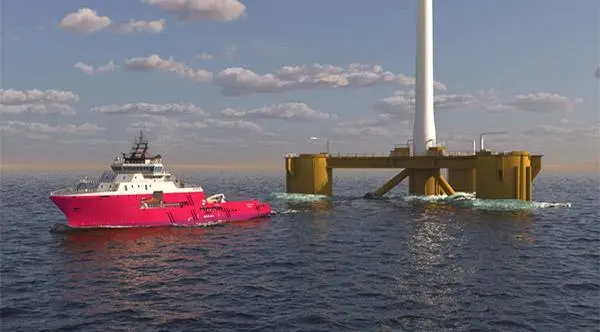
Merchant shipping giant Matsui OSK Lines (MOL) has agreed to work with Fukada Salvage & Marine Works to develop construction services for floating offshore wind projects.
Without explaining exactly what the two firms intend to do, a statement by MOL recognises the expansion of floating offshore wind around Japan is anticipated to be in deep-sea areas, given the limited shallow coastal areas in the region.
“MOL and Fukada will commence the study of efficient transportation and installation methods for floating offshore wind turbines,” it says. “In anticipation of accelerating the introduction of floating offshore wind turbines in the Japanese market in the 2030s, we aim to establish a joint ownership and operation system for new vessels suitable for transportation and installation of floating offshore wind turbines, as well as a procurement framework for mooring systems.
“Floating offshore wind turbines are normally assembled at a port and then towed to the installation site. After being towed to the installation site, their position is maintained by a mooring system consisting of anchors and mooring lines. This series of towing and mooring operations requires work vessels such as anchor-handling vessels.”
The partnership, it says, will aim to provide construction services with vessels and also procure mooring systems ‘through domestic and international cooperation’.
“We will continue to support power generation companies so that they can proceed with ease without the interface risks associated with the procurement of construction vessels and mooring systems,” it says.
In a June 2022 report by the Polish Wind Energy Association, WindEurope and others, Giles Dickson, WindEurope CEO, talks about the need for installation vessels as the size of turbines continues to grow – at the time being 10MW in power generation capacity.
That size has already been dwarfed by the increasingly common 15MW size, and recent reports have revealed a mammoth 20MW turbine has been prototyped.
The report warns of a chronic lack of availability of WTIVs by 2030 ‘due to the increase in turbine and foundation sizes’.
“The worldwide installation vessel shortage is a risk to planned project execution, and some project developments may have insufficient or in a worst case scenario no installation asset at their disposal,” it says. “The shortage is expected to lead to a deficiency in installation of annual installed capacity and hence reaching the 2030 government targets.”
With Japan’s offshore wind industry still at a very early stage, the country appears to be heading similar challenges off at the pass.
Related Articles
 OTHER NEWS
 ELECTRICAL SYSTEMS
 VESSELS