

MHO-Co unveils pair of electric CTVs
CTV designer, owner and operator MHO-Co has unveiled two vessels that in a change to previous designs does not use diesel engines for propulsion.
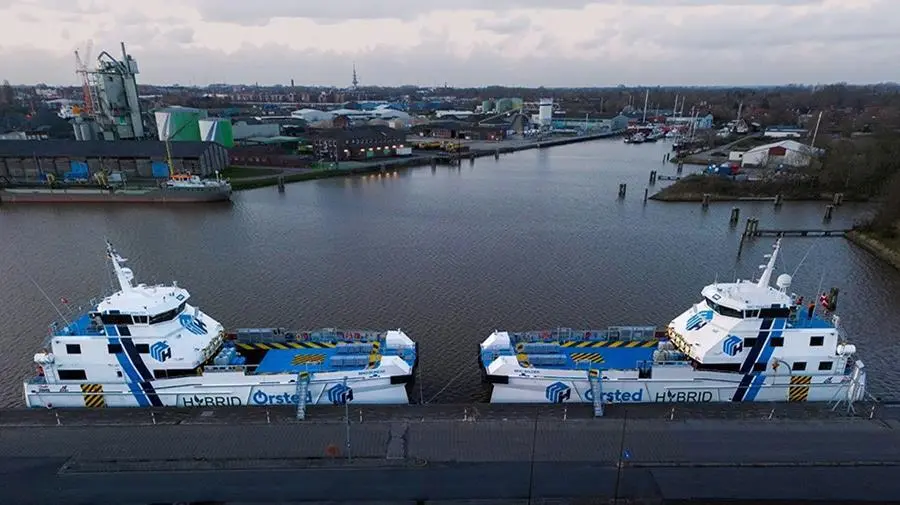
MHO-Boreas and MHO-Balder have fully integrated design that combine Danfoss Drives with IPS drivelines from Volvo Penta, which are fed by a battery bank for full electric mode.
Eight Volvo Penta D8 variable speed gensets are included to increase the vessel range, and the companies say that as in previous collaborations, they have ‘focused on maximum uptime, efficiency and manoeuvrability’.
“Because the drivelines are all-electric, we can create a future-proof design running off our drives and electric machines,” said Claus Larsen, head of Sales, Northern Europe, Central Europe and EMEA Marine & Electrification at Danfoss Drives. “There’s also the flexibility to run on future power sources (such as hydrogen or fuel-cells), once those are commercially viable.”
Volvo Penta says that its IPS can provide lower energy consumption levels than drivelines with shaft and fixed pitch propellers, because of its forward-facing, counter-rotating design. Energy savings, it says, will be analysed on the new electric versions.
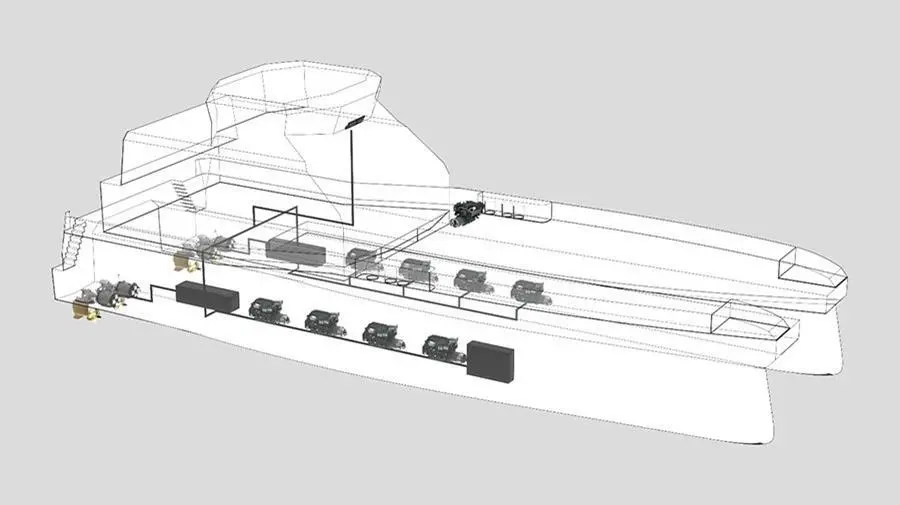
An engineering drawing showing the propulsion set-up inside the new CTVs
The Danfoss energy management system, battery bank and Power of Plenty generator network are designed to only deliver the power required, thus reducing energy use, says MHO-Co CEO Mik Henriksen.
“With the ‘Power of Plenty’ design, the gensets can be tailored to the load required,” said Lars Persson, Sales Project manager at Volvo Penta. “CTVs spend only a limited time running at full power and data shows that over 50% of the time they are running in idle mode. So, in situations that don’t require full power, the system can run on fewer gensets – even just one, when operating in the lowest setting.
“This allows the overall configuration to save running time and fuel consumption, helping to extend lifespan and reduce downtime.”
The two vessels have already begun operating transporting technicians to and from their work in the North Sea.