
Thames Tideway Tunnel update
Work has started on the construction of one the UKs largest civil engineering projects, the Thames Tideway Tunnel (aka the Super Sewer) a 25km tunnel running under the River Thames through west and central London, which is designed to channel and control between 39 and 50 million cubic metres of rain overflow which also contains raw sewage that currently flows into the river each year.
The construction of the new tunnel, estimated to cost upwards of £4.2bn, and taking seven years to complete, will replace the existing sewage system, built by Peter Bazalgette in the 19th century, which is still in good order but can no longer cope with the increased demands of the modern city.
The Tideway Tunnel will intercept overflow from the 34 most polluting Combined Sewage Overflows (CSOs), before transferring it to Beckton in east London for treatment. During construction, Tideway is aiming to transport 90% of spoil from the main tunnel by river. There will be extensive barge movements downriver on every tide with some sites shipping several barge loads per day.
The whole project, which will involve 70 worksites, including 11 riverside construction sites, extends from Acton to Beckton and has been divided into three sectors, with different consortia of contractors for each area.
The West section will be developed by a Joint venture of BAM Nuttall, Morgan Sindall and Balfour Beatty Group. The Central section involves a joint venture of Ferrovial Agroman UK and Laing O’Rourke Construction. The East section is contracted to a joint venture of Costain, Vinci Construction Grands Projets and Bachy Soletanche. Amey, the System Integrator, will be providing process control and communication equipment and software systems. Around £1.1 billion of the Thames Tideway Tunnel’s construction cost will be financed by Thames Water’s customers from increased water rates, and £3.1 billion by Bazalgette Tunnel Ltd.
Work starts at Blackfriars
After more than five years of consultation, planning and the awarding of contracts (see MJ June 2011), the first visible signs of construction activity were apparent late in 2015 around Blackfriars Bridge in central London.
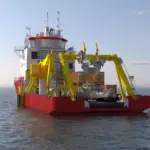
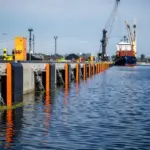
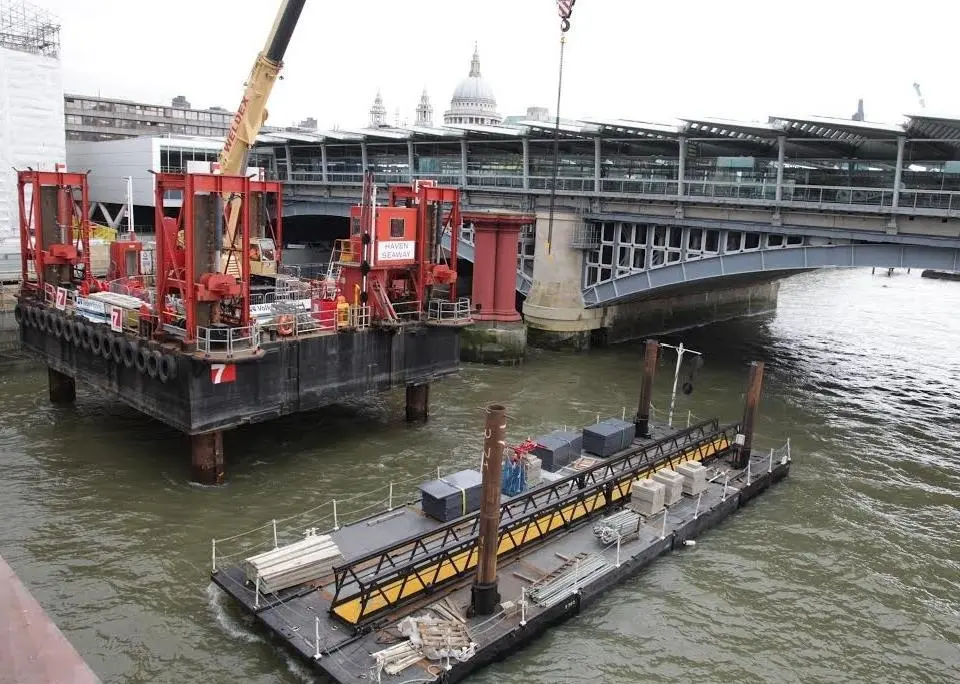
Red7 Marine’s jack up barge Haven Seaway was one of the first vessels to be deployed, starting on the construction of a new pier to replace the existing Blackfriars pier, which is being moved to make way for work under and around the road and rail bridges. The relocated pier is due to be completed this year to serve as a busy interchange for the Thames Clipper river bus services. Adjacent to the pier was moored the ex- HMS President, the 98-year-old WW1 veteran Q ship, which has now been tugged down to the Medway for restoration. The President’s mooring has also been removed.
Haven Seaway was hired by Volker Stevin, who required a jack up barge (JUB) to fit between the Blackfriars rail bridge and the road bridge, a space which is further obstructed by the remaining piers from the dismantled London and Chatham Railway bridge. Once on site the JUB had to be spun 180 degrees so that it could be moved into position between the old bridge foundations and the road bridge, a gap of 17m. The Seaway has a beam of 15m so was the ideal choice for this project. R7M commenced the mobilisation work at their Ipswich facility, shortening the 19m legs to 13m to aid safe transit of the Thames bridges, while 8m leg extensions were prepared for installation once on location. A 90t telescopic crane was also loaded. The GPS Battler towed the JUB to Northfleet, from where the CPBS tug Mad Dog, multicat Shake Dog and smaller workboats took over delivery upriver.
A passage plan was developed by R7M working closely with the Port of London Authority (PLA) and Volker to allow for air draught under the bridges and water depth for the increased draught of the Seaway. The plan was to start the final transit from Tower Bridge on a neap tide 2 hours after HW, arriving on site 3 hours after HW, leaving enough time to install the leg extensions. It was critical to have the legs installed before the next HW to be able to jack clear of the water
Labour shortage
Despite early concerns that there would be a shortage of craft to meet the demands of the job, it seems that most London-based tug and barge operators are gearing up for the increased workload, with several newly-acquired vessels expected to appear in the near future. However, according to one seasoned boat operator, there is likely to be a shortage of qualified labour in the early days. With this in mind, the Thames Training Alliance (TTA) was set-up to help address the increasing demand for trained skippers and crew (MJ, May 2012)
The PLA has been working closely with Thames Water for more than five years developing plans for the tunnel and issuing river works licenses. A dedicated harbourmaster has been appointed to oversee the work and additional staff have been recruited in their planning, environmental and hydrographic teams. The harbourmaster’s main role has been to ensure that navigational safety and environmental issues are properly addressed.
To help ensure the safety of all river traffic, the PLA will increase co-ordination of barge movements from the navigation control centre at Woolwich, provide local traffic control from launches where needed and monitor compliance with conditions in the river works licences. The PLA has stated it will do everything possible to mitigate the impact on river activities, although there will inevitably be some disruption during the tunnel’s construction
By Graeme Ewens