



Progress on Venice flood barriers
The challenge of protecting the ancient city of Venice from the sea has been a long saga. Increasing high tide levels within the sensitive Venice lagoon have seen many sections of the city flooded.
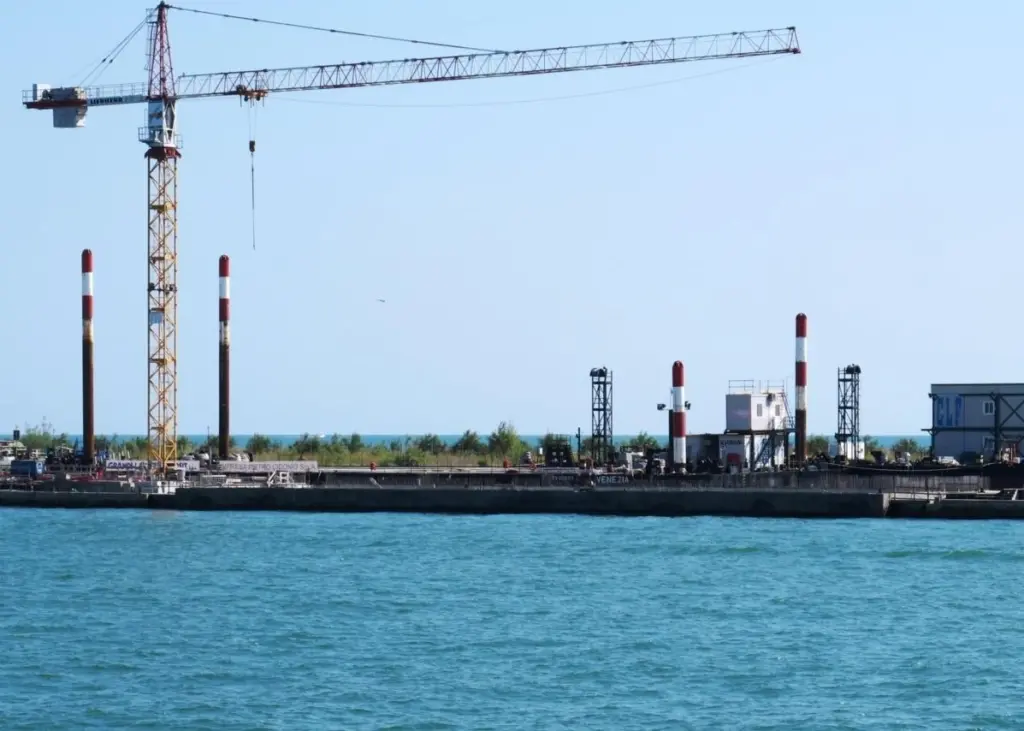
Work started on an ambitious project to enable the three inlets to the lagoon from the sea to be closed of by tidal barriers in the event of high tides and now the final stages of the project comprising the installation of the gates is being carried out.
Each of the three barriers comprises a series of modular gates that, when filled with water, rest on the seafloor. When high tides are forecast these hinged gates will be raised by filling them with compressed air.
In the 20th century, deep canals were dredged in the lagoon to allow big ships to reach the newly developed port and industrial petrochemical complex located at Marghera and more recently more dredging has allowed large cruise ships direct access to the island of Venice. It is thought that this dredging has been partially responsible for the increase in flooding rather than the fact that Venice is sinking
It was the record flooding of 1966 triggered the need for a definitive response. The city authorities quickly recognised that only the complete separation of the lagoon from the sea at high tide could safeguard the city. Nevertheless, the actual building only began in 2003. The MOSE concept is highly innovative in many respects. The four barriers being installed at the three lagoon inlets are made up of 78 independently operated gates of various sizes. Each gate lies horizontally on the seabed when not in use allowing shipping free access.
When needed, the water inside is pumped out by compressed air and the gates rotate into position under their own buoyancy. The visual impact of such a solution is minimal, and the whole barrage can be closed in just 30 minutes. Once operational, the historic city will be protected from tides as high as 3m. All three passages into the lagoon have been strengthened with new concrete walls and embankments. At the Lido inlet a new artificial island has been created in the main channel, allowing two separate barriers to be built to close the opening.
This new island will host all the service buildings that will be used to control the operation of the barriers. Three storm ports will be available for boats and ships that cannot access the lagoon when the barriers are closed and four locks have been built to allow the passage of vessels into the lagoon in similar circumstances so that the flow of traffic can be maintained. Three of these locks at the north and south inlets have small dimensions whilst at the middle inlet the lock is big enough to allow sizeable ships into the lagoon. This will allow the cruise passenger port of Venice and the industrial port of Marghera to remain operational even when the MOSE barrier is closed.
The old Arsenal, the former shipyard of the Republic of Venice in the centre of the city, is being restored and already hosts the main control centre. The barriers are not completely automated, unlike the Rotterdam surge barrier where control is delegated entirely to software. The MOSE barriers deployment has to be initiated by a human decision.
The nominal working inclination of the gates when closed is 45°, and the active control system keeps them as close as possible to this position by adjusting the quantity of water inside to act as ballast. There is a gap of a few centimetres between each gate, which will only allow small amounts of water through and obviates the need for seals.
Huge prefab concrete bases were embedded on the seafloor of each channel as a base for the hinged gates, which are coupled to their bases by 42-tonne hinges. This was a necessary part of the project because, for the barriers to operate, the sea floor must be completely flat.
Whilst much of the construction work on the supporting structures for this project such as the artificial island and the coast barriers had to take place in situ, the bases for the gate and the gates themselves were constructed at a yard developed in a section of the old Arsenale, the historic Venice naval base. Here, in addition to a production line system for the construction of the gates and their bases a harbour was built for the fleet of supporting craft required for this project.
The primary support vessel was a specially designed crane vessel that was built to transport and install the units. The Mose 1 is a large pontoon shaped vessel that can be moored accurately in position with four spuds. There is a lattice fixed crane at either end allowing the gates and structure to be lowered through a large moonpool into position on the seabed. There is a total of 78 gates to be installed at all three entrances
To protect the lock entrance located at the south side of the main inlet a 1000 metre long stone breakwater has been constructed outside the main entrance piers to the inlet. This curved structure is matched by similar protective structures constructed at the other two inlets.
During the construction work many of the main reinforced concrete elements of the structures were built in drained basins near the construction site. These were then flooded to allow the units to be floated out and positioned as required.
In total the barriers cover 1.6 kilometres of inlet. Each gate in the main inlet is 29.5 metres by 20 metres and 4.5 metres thick. The whole project is estimated to cost €5.496 million which is a 25% rise from the original estimate and final completion of the project is scheduled for between 2018 and 2020.
By Dag Pike
Related Articles
 ACCESSORIES & EQUIPMENT
 MARINE CIVILS
 MARINE CIVILS