Vroon enters offshore wind as market faces reality check

Screenshot 2026-09-14 134440
Vroon is entering the offshore wind market with its ERRV 'VOS Traveller'

Vroon Offshore Services (VOS) has won its first long-term contract to provide an emergency response and rescue vessel (ERRV) to an offshore wind project.

It is the company’s first step into the sector after decades of supporting offshore oil and gas operations.

The contract, worth more than £7 million (€8.2 million), has been awarded by ScottishPower Renewables for the build of the East Anglia 2 and 3 offshore wind farms off the Suffolk coast.

VOS will deploy VOS Traveller to provide emergency response and rescue cover during the build. The vessel will operate from Lowestoft, with a 24-person crew working on 28-day rotations.

The ERRV will maintain continuous standby and provide search and rescue support, including a place of safety within 20 minutes. Its equipment includes two fast rescue craft, a Dacon scoop and heavy-duty rescue basket, as well as onboard medical facilities.

The vessel will also provide radio watchkeeping, surveillance, field logistics and offshore environmental monitoring.

“It’s great to welcome Vroon Offshore Services to our East Anglia supply chain family as we build the infrastructure that will help deliver a clean energy future,” said Ross Ovens, ScottishPower Renewables’ Managing Director for Offshore. “Keeping our offshore construction sites safe and protecting the people bringing them to life is an intrinsic part of what we do, and VOS will have a vital role to play in supporting any emergency response.

“Working with partners like VOS, we’re injecting more than £3 billion into the UK supply chain right across the country and building a legacy that will have a positive impact for decades to come.”

The East Anglia projects are among a number of large offshore wind developments generating demand for construction support and safety vessels in UK waters. The requirement for ERRVs, crew transfer vessels, service operation vessels and other specialist craft is adding to the range of marine services required as projects move into construction.

Delayed operations

As Vroon makes its debut in the offshore wind sector, several reports are sounding warning bells about the current and future state of the industry.

Rapid expansion is being tempered by rising project costs, higher financing requirements and a growing willingness among developers to abandon projects that no longer offer acceptable returns.

TGS | 4C’s latest Global Market Overview estimates that global offshore wind capacity outside China expected to be operational by 2030 has fallen from 145GW to 120GW, a reduction of about 17% year-on-year. The consultancy nevertheless expects a significant increase in construction activity in the near term, with 15.9GW of projects forecast to reach final investment decision during 2026.

Spinergie has identified around 190GW of cancelled offshore wind projects globally, although it says roughly 50GW of this total represents projects suspended or cancelled directly by developers. It attributes the rationalisation to projects becoming financially unattractive as costs increased and revenue arrangements failed to keep pace.

BCG’s assessment of the market points to a similar change in developer behaviour. It says project costs have increased by 30-40% over the past two years, while higher interest rates, supply-chain constraints and policy uncertainty have put pressure on project margins.

Several European auctions have failed to attract bids, including the UK’s 2023 auction and unsuccessful tenders in Denmark and Germany.

The result is not an offshore wind market in retreat, but one becoming considerably more selective.

BCG expects a gradual recovery as supply-chain costs stabilise and governments adjust support mechanisms, but says the industry reset is likely to take several years.

Lower wind speeds create additional challenges

It’s not just the cost hurdle: offshore wind projects in Europe’s lower-wind regions face a weaker economic proposition than those in areas with stronger and more consistent wind, according to analysis from the Centre for European Policy Studies (CEPS).

The report, Beyond high winds: hard truths about ‘made in the EU’ offshore wind in lower wind regions, was published a year ago to look at the prospects for offshore wind in regions including the Black Sea and eastern Mediterranean.

CEPS said the lower wind speeds found in these markets translated directly into lower annual energy production, which in turn weakened project economics and made the regions less attractive to developers compared with established high-wind areas.

The report identified a ‘noticeable lack of developer interest and an overall weak business case’ as the principal challenges facing offshore wind development in these locations.

CEPS said technological adaptations could improve energy capture, but the fundamental disadvantage created by weaker winds would still be a factor.

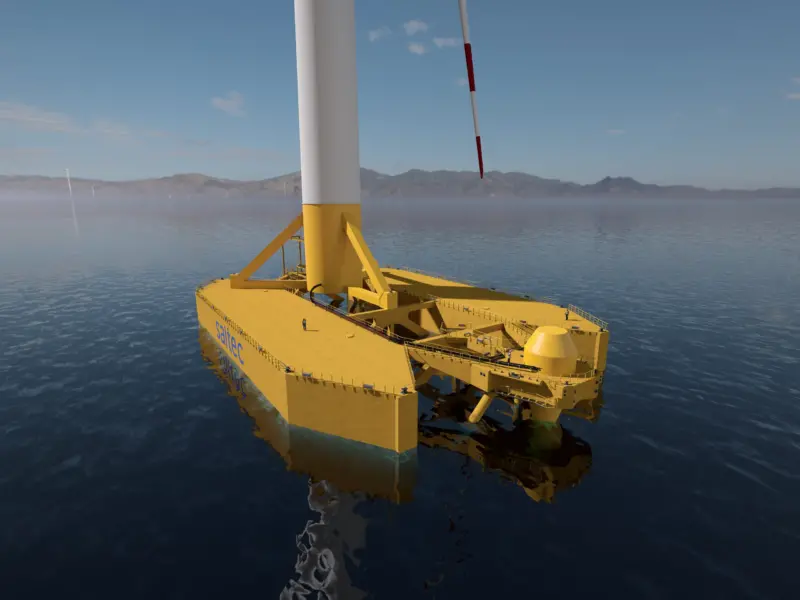
The report’s authors argue that lower-wind regions will therefore require a different approach if offshore wind is to develop at scale. They identify floating wind technology as one potential route, allowing turbines to access deeper waters and potentially better resources.

Floating wind brings its own cost challenges. The Financial Times recently reported that floating projects can currently cost two to four times more than fixed-bottom offshore wind, underlining the economic challenge facing development in more difficult offshore environments.