Operational review: Five years of running a hybrid passenger catamaran

After five years transporting 750,000 passengers on a hybrid catamaran, Mundo Marino technical director David de Haro talks to Maritime Journal about the pros and cons of the technology.

DCIM100MEDIADJI_0065.JPG
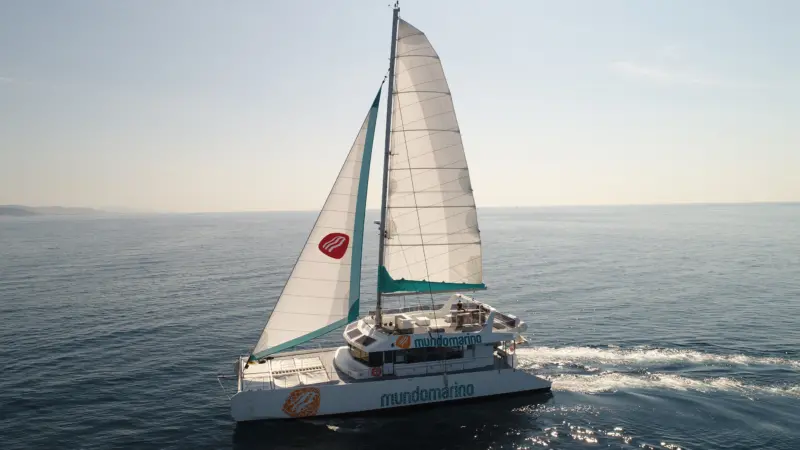
Mundo Marino hybrid passenger catamaran

When the Mundo Marino Eco passenger catamaran entered service in 2020, its hybrid propulsion system was unusual for a commercial excursion vessel in the Mediterranean.

Five years and around 750,000 passengers later, its operators have a much clearer picture of what the technology delivers – and where the complications lie.

Mundo Marino is a Spanish nautical-tourism company operating along the Mediterranean coast, with departure bases including Valencia, Gandía, Dénia, Jávea, Calpe, Altea, Almería and Málaga. It operates sightseeing and sailing excursions, catamaran trips, private and corporate events, and other passenger-boat experiences.

Technical director and naval engineer David de Haro decided to launch the project to see how far fuel and emissions could be reduced while maintaining the reilability and flexibility the boat needed for this line of work.

The sailing passenger catamaran was built by Astilleros Dalmau, with a Torqeedo Deep Blue hybrid system supplied and integrated by Viatec, a Mundo Marino group company.

Torqeedo Deep Blue 50 R system

The system comprises two 25kW electric motors, 40kWh lithium-ion batteries, power electronics, rapid shore charging, onboard electricity generation by diesel generator, solar panels and hydrogeneration.

The vessel itself cost around €1.5m, with the hybrid system adding another €300,000 – about 20% of the vessel’s cost. The project received no public subsidy.

Mundo Marino technical director and naval engineer David de Haro says the vessel was never intended to be a prototype.

“Mundo Marino ECO was designed as a working passenger vessel, not as a prototype,” he says. “We wanted to see how far we could reduce fuel use and emissions while keeping the reliability and flexibility we need in daily tourist operations.”

The vessel was designed around three principal sources of propulsion: sail, electric power and diesel. Sail is used whenever conditions permit; the electric motors are intended principally for manoeuvring and low-speed operation; and diesel provides range and operational redundancy.

“We wanted to use each system where it works best,” says de Haro. “The advantage is flexibility. The skipper can choose the most efficient combination for the conditions instead of running the diesel engines by default.”

Built for intensive commercial operation

This is not a lightly used demonstration vessel. The operational records show around 150,000 passengers a year, an average of five departures per day and approximately six nautical miles per departure. Over five years, the vessel has accumulated about 750,000 passengers and 54,750 nautical miles.

That operating profile has proved important to how the hybrid system is used.

The electric propulsion is concentrated on harbour arrivals and departures; berthing and unberthing; short repositioning; approaches to bathing areas; anchoring and anchor recovery; maintaining position during events; following regattas; and operations close to environmentally sensitive areas. The motors can also provide occasional assistance while sailing.

Electric propulsion is most useful at low power, says de Haro.

“Harbour manoeuvring, arrivals and departures, short repositioning and low-speed operation are very good applications. Noise and vibration are much lower and we do not need to start a diesel engine every time we need a small amount of propulsion.

“It also changes the way the skipper thinks about the trip. You start asking how little power you actually need for each part of the operation.”

Leaving and entering harbour is, he says, the clearest example of where the electric system makes a practical difference.

“Conventional engines are not at their best at very low loads, while electric propulsion is very comfortable there,” he says.

The electric motors can also provide a small amount of power in light or variable wind, maintaining steerage or the vessel’s schedule without immediately starting the diesel engines.

“None of these uses is spectacular on its own, but they happen repeatedly during normal operations, and that is where hybrid propulsion becomes genuinely useful,” he says.

Sail remains central

Despite the focus on electrification, the five-year experience has reinforced the importance of the catamaran’s sailing capability.

“Sailing is probably still the most important renewable-energy system on the vessel,” says de Haro. “When conditions are good, the sails do most of the work. Electric propulsion is a very good complement because it can provide a small amount of power during wind shadows, manoeuvres or when we need to maintain a timetable.

“Commercial sailing is rarely 100% sail or 100% engine. There are always transitions, and electric propulsion handles those transitions very well.”

The vessel can also use its propellers for hydrogeneration while sailing. Under favourable test conditions – around 20 knots of wind, a sailing speed of 5-6 knots and no passengers – the system produced approximately 1kW per motor, or 2kW in total. With passengers aboard and around 10 knots of wind, the regenerated power was less than half that level.

“The amount recovered depends on vessel speed and sailing conditions, and regeneration also creates drag,” he says. “In good sailing conditions it contributes to the energy available onboard, but we do not see it as a replacement for shore charging. The main energy saving still comes from good sailing and avoiding unnecessary engine use.”

Shore power: the economic problem

One of the clearest findings from five years of operation concerns the cost of electricity ashore.

In Málaga, the average cost of electricity supplied in port has been around €0.47/kWh. The report puts the cost of generating electricity onboard at approximately €0.25/kWh when marine fuel costs around €1/litre and generator efficiency, consumables and engine maintenance are included.

Shore electricity is therefore about 88% more expensive on the figures recorded by the project.

For an operator investing heavily in electrification, that creates an uncomfortable situation: the cleaner charging option is also the more expensive one.

“Shore power is critical to the economics,” says de Haro. “If you have to run a diesel engine to generate electricity onboard, then charge a battery and later use that electricity through an electric motor, much of the economic and environmental advantage disappears.”

The preferred arrangement is straightforward: charge directly from the port grid at a commercially viable price.

But that requires more than a charging socket. De Haro says ports need sufficient available power, practical berth connections and charging arrangements that fit around the vessel’s operating schedule.

“Better shore infrastructure would make a very big difference to electrification in the Mediterranean,” he says.

The report calls for dedicated maritime charging tariffs, transparent separation of energy, power and other charges, individual metering and better availability of electrical power during vessel turnaround periods.

Less mechanical maintenance; more electronics

The five-year experience has also exposed a significant shift in maintenance requirements.

Electric propulsion removes some of the routine mechanical work associated with conventional engines, but it does not eliminate maintenance.

“The maintenance does not disappear. It moves elsewhere,” de Haro says.

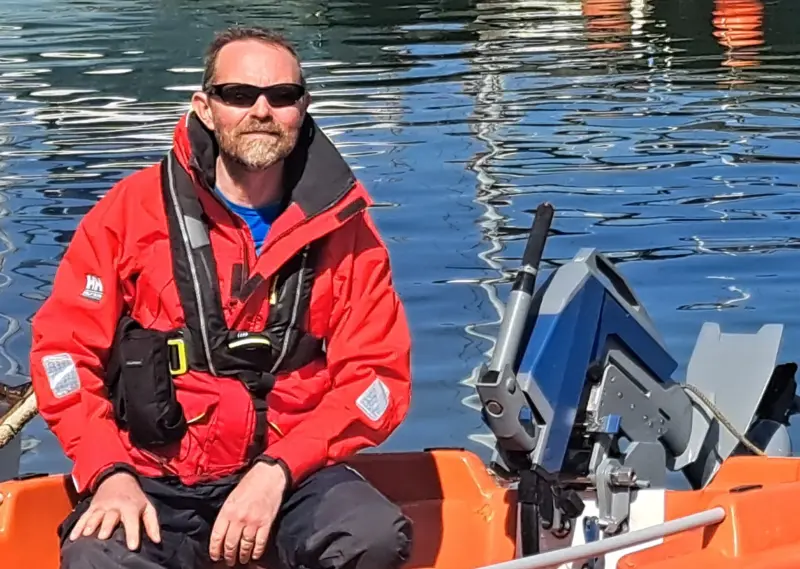
David de Haro

The areas requiring attention include inverters, battery-management systems, sensors, cooling, connectors, communications and software diagnostics.

“A mechanical fault can often be understood quite quickly by an experienced marine engineer. An electronic or communications problem may require specialist software or support from the manufacturer.”

That dependence on specialist support has operational consequences.

“For us, access to diagnostics, spare parts and good technical support is now an important part of choosing a system.”

The marine environment adds another layer of difficulty. Salt, humidity, condensation, vibration and temperature changes can affect connectors, cable entries and cooling systems even where the underlying electrical component is sound.

“We have learned to pay much more attention to installation details, sealing, ventilation and preventive inspection,” he says.

De Haro says a component can be electrically sound but still cause problems if it has not been properly marinised or installed for prolonged exposure at sea.

Specialist skills and support

The maintenance implications extend to personnel.

“You need both traditional marine engineering and electrical knowledge,” he says.

Crew members do not need to become high-voltage technicians, he says, but must understand propulsion modes, alarms, isolation procedures and basic energy management. Maintenance personnel need knowledge of batteries and power electronics alongside conventional marine machinery.

Remote diagnostics and after-sales support are particularly important.

“A tourist vessel cannot sit idle for several days waiting for a specialist to travel from another country.”

The report identifies high-voltage training, access to diagnostic software and telemetry, electronic spare-parts availability and close coordination between owner, integrator and manufacturer as key lessons from the project.

Battery performance

After five years, the 40kWh lithium-ion battery bank remains in good condition, with capacity loss described as compatible with normal system depreciation. The relatively moderate battery duty cycle is significant: the vessel uses electrical power mainly for manoeuvring and low-speed work, avoids systematic deep discharges and has thermal propulsion and sail available for the rest of the operation.

De Haro’s advice is not to treat the battery as something that must be fully charged and discharged on every trip.

“Good monitoring, temperature control and avoiding unnecessary deep cycling are important, and the battery should be sized around the vessel’s actual operating profile; we prefer to use electrical energy where it gives us the greatest benefit rather than trying to maximise electric range on every voyage.”

The system can also supply other onboard electrical loads, including bow thrusters, AC inverters, 24V chargers and converters, lighting, electronics, hotel services, pumps and domestic consumption.

What comes next

The Mundo Marino Eco’s five years of operation have led to a second vessel, the Mundo Marino Sostenible, which is complete and awaiting certification, with entry into service expected during 2026. Its propulsion architecture is described as equivalent to that of the Eco.

Mundo Marino catamaran

For de Haro, however, the principal lesson is not that one particular propulsion system should become standard: indeed, one of the main lessons learned is specifically that.

The route, distance, speed, weather, time in port, passenger capacity and access to shore power all need to be considered before the propulsion and battery system is specified.

The next vessels are being developed with better integration, easier maintenance, robust marine electronics and good diagnostic access, he says.

For the wider sector, his priorities are better shore charging, financing for the higher initial investment and stronger local service networks for high-voltage marine systems.

The project’s decarbonisation story is therefore inseparable from its operational lessons: sail remains important, electric power has proved particularly useful at low power and the battery has survived five years of commercial use. But the experience also shows that electrification brings its own infrastructure, maintenance and support requirements.

“Our aim is not to have one ‘green boat’ in the fleet,” he says. “It is to improve the fleet progressively, using sail, electric propulsion, efficient hulls and better energy management wherever they make practical sense.”