Fractured future: Harbour tugs face unprecedented challenges
European ports are electrifying, but their focus on large vessels is leaving harbour tugs behind, writes Grace Waters. The slow-charging infrastructure struggles to meet the rapid, high-power needs of these essential workhorses.
Such a gap, combined with indirect pressures from customers and ports, is forcing tug operators to find their way through a treacherous and fragmented landscape of competing green fuel technologies on the rocky road to decarbonisation.
The scope of Europe’s green ports initiative
The European Union has committed to aggressive decarbonisation targets across its maritime sector. Two regulatory frameworks currently drive the transformation under way at port terminals across the continent:
- The FuelEU Maritime Regulation sets greenhouse gas intensity reduction targets and mandates the use of onshore power for container and passenger ships from 2030 onward.
- The companion Alternative Fuels Infrastructure Regulation governs how ports deploy the physical charging infrastructure needed to support that shift.
Together, these regulations establish a timeline that leaves port authorities and vessel operators with limited room for delay. Vessels with a gross tonnage above 5,000 that call at EU ports will face penalties if they fail to meet emissions benchmarks and ports must build out shore power capacity to accommodate the vessels using their berths.
The regulatory pressure has triggered a wave of investment across Europe’s largest maritime hubs, with terminals racing to install systems that can deliver electricity to docked vessels in place of their onboard diesel generators. Compliance alone does not capture what ports stand to lose. Terminals that fail to provide adequate shore power risk losing business to competitors who can offer greener berthing options.
The choice between paying penalties and securing access to charging infrastructure will shape vessel operators’ fleet planning decisions for the next decade.
An electrification strategy built for large vessels
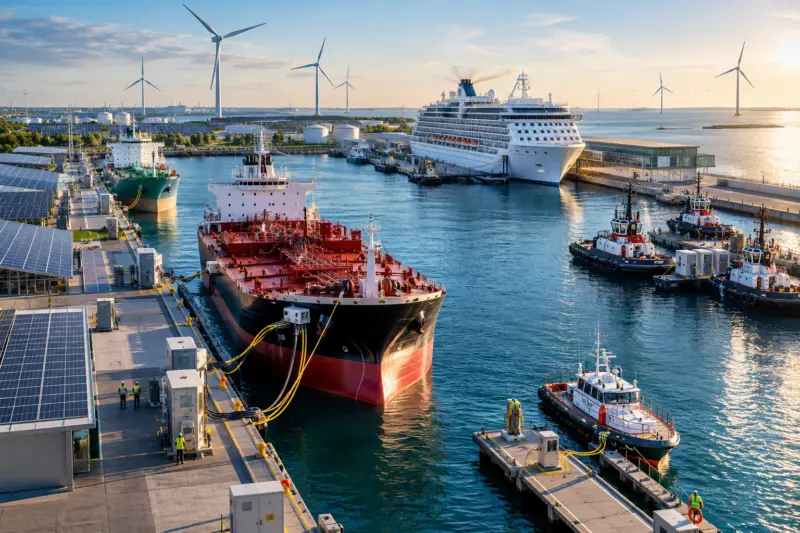
Port planners designed the first generation of shore power infrastructure around the needs of container ships and cruise vessels. These large vessels dock for extended periods and draw consistent and predictable loads and the engineered cold-ironing infrastructure reflects that use case. Long cables run from shore-based substations to berthed vessels, delivering power through high-voltage connections that replace shipboard generators during port calls.

Major European ports have invested heavily in this model.
CINEA’s AFIF project list identifies OPS projects for large-vessel berths in Rotterdam, Tallinn and Ancona, alongside broader port-electrification work in Barcelona, underscoring how much public and private funding is flowing towards berth-based power systems.
The infrastructure choices made during this phase align with broader goals around Europe’s strategic autonomy in energy and transport.
However, the early builds did not account for the vessels moving between berths.
Harbour tugs operate on a completely different schedule, with power needs that peak during brief windows between assignments. The infrastructure designed for long, continuous draws cannot serve vessels that need rapid, high-intensity charging.
Power needs of harbour tugs is not accounted for
A container ship at berth draws power to run lighting, ventilation, refrigeration units and other onboard systems, and the load remains relatively constant. A harbour tug burns through energy in short, intense bursts while manoeuvring vessels into position, then it returns to standby. This means operators need their tugs recharged and ready for the next job within minutes.
The cold-ironing systems in place across European ports cannot accommodate that operational tempo: the cables designed for large vessels take time to connect and disconnect, and charging rates assume vessels will remain stationary for extended periods.
A tug operator working multiple assignments per shift cannot afford the downtime needed to plug into existing shore power infrastructure between jobs. The new business model required to serve high-duty vessels introduces complications that early planners chose to defer rather than address.
Maritime operators have long dealt with complex regulatory frameworks. Just as US vessels over 39.4 feet in length must carry navigation documentation to stay safe on the water, tug companies adapt to layers of operational requirements.
Fairplay participated in Geneva Dry 2026 as part of the Tug Network Team, a coalition working to shape the sector’s future together. The company’s perspective highlights the relational dimension of maritime work. “Fairplay is not just operating at the edge of the dry bulk world, we are part of its core. Close, reliable partnerships are what make the difference in this industry over the long run,” it said.
Boluda Towage earned recognition as Innovation Company of the Year at the 2026 ITS Awards for implementing Total Energy Optimization Systems on newly built tugboats. According to the company, “the technological upgrade directly reinforces Boluda Towage’s long-term decarbonisation roadmap and corporate sustainability objectives, aligning fleet development with international emissions reduction targets.”
Indirect pressures on tug operators
While regulations like FuelEU Maritime do not currently apply specifically to vessels under 5,000 gross tons, it would be a mistake to assume tug operators are free from pressure.
The true forces shaping their decarbonisation journey are indirect, but no less powerful. Customer demands and stringent port compliance rules are creating a de facto mandate for tugs to go green, forcing operators into a complex maze of decision-making with competing and incompatible fuel pathways.
Customers, primarily the global shipping lines, charterers and terminal operators, indirectly dictate how towage companies operate by prioritising maximum efficiency and minimal financial risk.
The major shipping lines that charter these tugs face their own pressure from cargo owners to decarbonise their supply chains.
UK port authorities, governed by the Port Marine Safety Code, impose strict local rules to maintain their own compliance and reduce liability. This creates a top-down pressure that inherently limits and controls tug operations.
Three competing fuel futures
This web of indirect pressures is forcing operators to invest in new, cleaner technologies but the problem is that the infrastructure response from ports is not uniform.
Some are betting on batteries and shore connections, while others pursue hydrogen distribution. Others are backing liquid alternative fuels, creating a central conflict where an operator must choose a technology path that may not be supported everywhere.
Pathway 1: The push for shore power infrastructure
Some major ports are betting heavily on cold ironing, or on-shore power. The Port of Antwerp-Bruges, for instance, is committing €25 to €30 million to install two shore connections. This model of integrated renewable generation and shore power constitutes the full infrastructure commitment that some ports are making to attract electric vessels.
An operator serving Antwerp regularly would find battery-electric propulsion makes strategic sense. One serving a mix of ports faces far more complicated calculations, since the infrastructure that works in one location may leave vessels idle in another.
Pathway 2: The promise of regional hydrogen hubs
Other port regions in the world are betting on a different technology entirely.
The Pacific Northwest Hydrogen Hub in Seattle, for example, aims to kick-start the hydrogen economy and reduce costs to $1 per kilogram.
For operators evaluating fuel-cell propulsion, the promise of low-cost hydrogen is compelling, but the risk is that these facilities remain concentrated in a handful of hub regions.
Building refuelling capacity requires entirely new distribution networks and safety protocols, which entail significant capital requirements.
Pathway 3: The quiet rise of methanol and biofuels
Alternative liquid fuels, such as methanol, are gaining traction as a third path.
Advanced mechanical hybrid solutions, such as the Schottel SYDRIVE-M, enable a vessel’s two thrusters to be driven by a single engine. This helps operators meet stringent environmental requirements that extend past emissions alone, including reducing underwater radiated noise.
“The mechanical hybrid solution allows the two thrusters per vessel to be driven together by only one of the main engines,” says Schottel. “This reduces main engine operating hours, resulting in lower maintenance costs as well as less fuel consumption and lower emissions.”
The broader environmental imperative driving these fuel transitions is underscored by some climate data showing that the Arctic sea ice has lost two-thirds of its thickness since 1958, which environmental groups claims reinforces the need for rapid decarbonisation across all maritime sectors.
Methanol offers the advantage of existing bunkering infrastructure in many ports, however, green methanol supply chains are underdeveloped, and prices remain volatile compared to conventional marine fuels.
Hidden risks and tough decisions

Traditional diesel-electric systems have decades of operational history. Hydrogen fuel cells and battery arrays carry none of that. Among the lesser-documented risks are stray electrical currents that discharge into surrounding structures, a concern that newer technologies lack the maintenance history to address. The lack of field data makes accurate life-cycle budgeting nearly impossible.
For instance, a tug fleet committing to hydrogen today cannot reliably estimate the cost of fuel cell replacement in 2035 or whether trained technicians will be available at every port. Certification standards also vary widely between regions, and the training infrastructure is only beginning to take shape.
Tug operators currently face a decision between attempting to retrofit existing diesel-electric tugs or investing in entirely new vessel designs. Retrofitting might cost less up front, but carry technical uncertainty.
The newbuild option offers an optimised, ground-up approach. However, the cost barrier is high, and commissioning new tugs when port charging or refuelling specifications remain undefined introduces substantial risk.
Time pressures make the issue more complicated. FuelEU Maritime mandates took effect in 2025, and the onshore power mandate for relevant vessel categories begins in 2030. However, vessel design and construction timelines can span multiple years. Operators who delay decisions risk finding themselves with aging diesel fleets in a regulatory and commercial environment that penalises high emissions.
How industry leaders manage a fragmented market
Major tug operator Svitzer acknowledges the challenge of directly operating across fragmented infrastructure. According to Gareth Prowse, the company’s head of decarbonisation, “Svitzer’s global footprint means we operate in highly varied regulatory and market environments. To navigate this complexity, we take a locally tailored but globally scalable approach.”
Similarly, engine manufacturer Wärtsilä sees adaptability as central to the industry’s future.
“The energy transition will not be one-size-fits-all,” it says. “Fuel flexibility is important because no single fuel will dominate the market, and vessels may need to switch fuels during their lifetime.”
What both companies are describing is a market without consensus.
Companies need strategies that can adapt to multiple infrastructure paths at once, preserving the ability to serve markets regardless of local frameworks. This approach comes at a cost, but so does committing too early to the wrong standard.
Tug operators are caught between an ill-fitting infrastructure and a fragmented fuel market. Their path forward goes beyond compliance and demands a strategic gamble on a future that has yet to be built. The industry’s ability to adapt will determine not just fleet viability, but the operational resilience of Europe’s green ports.