
RWE and KKR win record £12.8bn financing for offshore wind

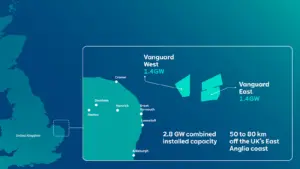
Financial close has finally been achieved on a 2.8GW offshore wind development off the east coast of England.
Energy firm RWE and investment company KKR have described the deal as the largest ever ‘non-recourse’ financing for UK offshore wind, meaning that the lenders will not have any general claim against the wider business of the borrowers if the project itself cannot repay its debt. Instead, the lender relies on the assets, contractual arrangements and anticipated future revenues of the project.
The companies aim to build and commission the wind farms Vanguard East and West by 2030, beginning early next year.
The financing comprises £11.1 billion (€13.2 billion) in cash facilities and a further £1.7 billion (€2 billion) in ancillary facilities, obtained from a consortium of 35 international banks. It includes a £1 billion commitment from the UK’s National Wealth Fund, alongside credit cover from Germany’s Euler Hermes and Denmark’s Export and Investment Fund (EIFO). The transaction represents the first participation of both the National Wealth Fund and Euler Hermes in a UK offshore wind project financing.
RWE and KKR have also completed their 50-50 joint venture transaction, with RWE leading project delivery alongside KKR’s long-term investment capital and infrastructure expertise.
Both projects signed a 20-year, inflation-indexed Contracts for Difference in January 2026, at a strike price of £91.20/MWh in 2024 prices.
Government and investors welcome landmark financing
The announcement has been welcomed by the UK Government, RWE and KKR, with the involvement of public and private capital highlighted as an important factor in delivering major energy infrastructure.
“This is great news for billpayers because every turbine we put up is power under British control, not at the mercy of events on the other side of the world,” said UK prime minister Andy Burnham.
“Our strategic partnership with KKR provides a strong foundation for the joint delivery of Vanguard West and Vanguard East, and is a vote of confidence in the UK as an attractive place to invest,” said RWE CEO Markus Krebber. “Securing the largest ever project financing in UK offshore wind also demonstrates our lenders’ trust in these projects and our ability to deliver them.”
“The UK has a significant opportunity to develop its critical infrastructure to support long-term economic growth and strengthen energy security, including through offshore wind,” said Vincent Policard, co-head of European Infrastructure at KKR. “Delivering at this scale requires substantial private investment, and KKR brings long-term capital, global infrastructure expertise and the ability to support complex projects through construction and operation.”
Financial close hurdles
Reaching financial close is often one of the most challenging stages in the development of a large offshore wind project. Getting planning consent, winning a government-backed Contract for Difference and agreeing a partnership with investors are all important milestones, but they do not necessarily mean a project will continue to construction.
 Developers must still secure billions of debt and equity, demonstrate that future revenues will support repayment, and satisfy lenders that construction, procurement and operational risks are manageable. Rising interest rates, inflation, supply chain pressures and competition for bank lending can all make this process more difficult.
The Competition for Capital: Financing Europe’s Offshore Wind at Scale report published by Mitsubishi UFJ Financial Group (MUFG), one of the world’s largest banking and financial services groups, in May identified structural constraints on commercial bank lending as a potential threat to Europe’s offshore wind expansion.
It highlighted the growing scale of financing requirements, changes to bank capital requirements and competition for lending capacity from other sectors.
Scotland’s Inch Cape 1.08GW offshore wind project reached financial close in January 2025, securing more than £3.5 billion (€4.1 billion) of funding from a consortium of 22 commercial banks. According MUFG, the process involved 18 months of negotiations and problem-solving, with inflation, higher interest rates and a reduced appetite for risk among suppliers adding to the challenges.
The consequences of failing to maintain a viable investment case were illustrated by Ørsted’s decision in May 2025 to discontinue Hornsea 4 in its current form. Despite having secured a Contract for Difference for the 2.4GW project, the developer cited continued increases in supply chain costs, higher interest rates and increased construction and operational risks.