Shore power: Plugging in is just the first step

In a webinar hosted by the European Onshore Power Supply Association (EOPSA), CEO Roland Teixeira quizzed representatives from the ports of Rotterdam and Bilbao about how they were installing it.

Shore Power

The ports of Bilbao and Rotterdam are taking different routes to shore power, but both are finding that the real challenges lie way beyond the connection itself.

Shore power is not new: ships were being connected to electricity at berth during the Second World War, when the objective was to eliminate noise, vibration and fumes that could reveal a vessel’s position.

The image shows Roland Teixeira, president of the European Onshore Power Supply Association (EOPSA) at Seawork
Roland Teixeira, president of the European Onshore Power Supply Association (EOPSA) at Seawork

It was in that era, according to Roland Teixeira, president of the European Onshore Power Supply Association (EOPSA), hosting a webinar to discuss shore power this week, that the term ‘cold ironing’ originated: ships receiving power while their engines were turned off and therefore ‘cold’.

But while it’s not new, it’s certainly different today.

The growth of renewable electricity, increasingly mature shore-power technology and European regulation are converging to make OPS a central part of port decarbonisation.

A key driver is the EU’s Alternative Fuels Infrastructure Regulation (AFIR), which sets requirements for alternative-fuels infrastructure across Europe, including shore-side electricity provision for certain vessels and ports.

But discussions at the webinar among EOPSA, the Port of Bilbao and the Port of Rotterdam suggest that the industry’s next challenge is not simply getting ships connected – it is building an electricity system capable of supporting the increasingly electrified port.

System project, not just vessel connection

At Bilbao, OPS is no longer being developed as a standalone service.

Ekaitz Lopez Amurro, CFO and EU Funds Coordinator at the Port of Bilbao

Ekaitz López Amurrio, CFO and EU Funds Coordinator at the Port of Bilbao, described the port’s network as the ‘backbone’ of a future port energy system.

The port is developing 11 shore-power connection points for cruise ships, container ships, ferries and ro-ro vessels, alongside four photovoltaic plants. The longer-term plan is to add up to 50 MW of renewable generation and 16 MWh of storage.

The ambition is to move from simply consuming electricity to producing, storing and sharing it across the port community.

That could include shipping lines, terminals and industrial users, with the Port Authority acting as an orchestrator.

“What we have learned is that higher levels of integration make the model more competitive, but also more complex,” he said, adding that each port would have to do it differently. “And it becomes somehow a governance, not just a technology deployment or a financial issue.”

Grid capacity constraint

The biggest constraint facing electrification may ultimately be outside the port’s control.

Bilbao currently has a 30MW electrical substation. By 2030, the port expects its energy requirement to reach 175MW. OPS will be only one source of additional demand, alongside offshore-wind manufacturing, e-fuels, electric truck charging and electrified cargo-handling equipment.

Jasper van Dijke, Program Manager Shore Power at Rotterdam

Jasper van Dijke, Program Manager Shore Power at Rotterdam, said parts of the port currently have no capacity to increase their electricity contracts.

“There’s basically a waiting list throughout the Rotterdam area and that’s also the case across the Netherlands. We really have a serious issue here,” he said.

New grid infrastructure is being developed, but van Dijke puts the potential timeframe for additional capacity in the Rotterdam area at around 2032–2036.

That means the question for a terminal planning OPS is not simply what equipment is needed; it is when the power can actually be used.

And because demand is rising across the port simultaneously, OPS projects are competing with a much wider electrification programme.

No one size fits all

Who pays for OPS – and who carries the risk – is another question without a single European answer, so Rotterdam is offering several models.

For public berths, the Port takes responsibility for installing shore power. Private terminals can alternatively develop projects themselves, taking responsibility for design, tendering, contractors and financing.

There is also a third option: Rotterdam Shore Power, a joint venture between the Port of Rotterdam and energy company Eneco, can take on a project for a terminal. Instead of the terminal providing all the capital expenditure itself, the arrangement effectively operates on a lease-type basis, with the joint venture financing the infrastructure and recovering its investment through the shore-power service.

“It’s a model that makes implementation a lot easier for the terminals,” said van Dijke. “It also limits their risks because the joint venture takes on the financing risks. And in that sense, the terminal is a tool to facilitate after implementation because for each individual terminal it can be a quite complex process to manage and project to manage.”

Bilbao is taking a more central coordinating role, with the Port Authority attempting to accelerate electrification and bring different stakeholders into a common energy model.

The European picture, therefore, is likely to remain diverse: port-funded infrastructure in some locations, terminal investment in others, and third-party or joint-venture models elsewhere.

Tanker challenge

Port of Rotterdam
Port of Rotterdam

The next stage of shore-power deployment will not simply involve putting more connections on existing vessel segments.

Rotterdam is looking particularly closely at tankers because of their greater emissions: cargo handling on tankers can require significant amounts of energy because it has to be pumped out, and the sheer number of tanker calls makes the segment an important source of emissions in Rotterdam.

“The pumping side is quite energy intensive and we have a lot of tanker calls so in absolute terms, they’re the biggest emission generator,” van Dijke said.

“But then there are also the smaller chemical tankers. The nice thing about those is that they can use shore power to power their pumps – so if you connect a chemical tanker to shore power, we could have near zero-emission cargo operations as well from the vessel side.”

The port is carrying out feasibility work on both the technical and business-case sides and wants to bring terminals, ports and shipping companies together as early movers.

It emphasises the fact that there is no universal OPS solution. Vessel design, cargo operations and terminal hazards all influence how electrification can work.

Battery back-up

Renewable generation creates an obvious problem for ports: electricity is not necessarily available at the moment a ship needs it, and Bilbao expects wind and solar generation to fluctuate while vessel demand follows a completely different pattern.

Cruise ships, for example, do not turn up every day – far from it.

“Windmills and PV plants also depend on the time of day, summer, winter, so they don’t match power demand,” said López Amurrio.

Energy sharing can help, but Bilbao also sees storage as a core part of its future system.

The timing of vessel arrivals does have one advantage: OPS demand can be anticipated in advance.

Rotterdam is considering storage from another angle – reducing peaks in electricity demand.

Van Dijke says batteries could potentially allow terminals to ‘shave’ their peaks, reducing the amount of grid capacity they need to contract for.

In a congested grid, that could become an increasingly important part of the business case.

The battery, in other words, may become part of the port’s grid strategy rather than simply an accessory to an OPS installation.

Digitalisation

The physical infrastructure may be the most visible part of OPS, but the digital layer is becoming just as important.

Port of Bilbao old
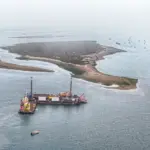
That was then: the old Port of Bilbao

Bilbao discovered this during the development of its photovoltaic plants. The software requirements were not initially given sufficient consideration, particularly because the PV installations needed to interact with the OPS network.

“But then we realised that it had to be from the very beginning designed and included, so this is part of the project right now,” said López Amurrio.

As the port moves towards a system in which electricity is generated, stored and shared between multiple users, the need for software integration becomes greater still.

Rotterdam is looking at a new software architecture based partly on the systems used for electric-vehicle charging.

The objective is to allow different applications to work with a common architecture and to collect the information needed to manage multiple connection points and energy users.

For vessel operators, this digital infrastructure could ultimately determine how OPS is booked, managed, monitored and paid for.

It also points to a wider truth: once a port has multiple ships, terminals, renewable generators and storage systems drawing on the same electrical network, managing the information becomes part of managing the energy.

The plug is only the beginning

The message from Bilbao and Rotterdam is not that shore power is becoming so important that ports can no longer treat it as an isolated piece of infrastructure.

The two ports are approaching the challenge differently, but both are grappling with the same questions: where the electricity will come from, how much grid capacity will be available, who will finance the infrastructure, how renewable generation and storage can be integrated, and how the resulting system will be managed.

Teixeira de Mattos’s answer to what will drive OPS adoption over the next five years was simple:

“More funding” – though where that will come from also remains to be seen.

López Amurrio said support needs to extend beyond the shore-power connection itself and include all the components – such as renewable energy systems and substations.

The first generation of shore-power projects was largely about connecting ships to the quay.

The next generation is about integrating them in the port’s entire energy system.