![MaritimeJournal[Seawork]](https://www.maritimejournal.com/wp-content/uploads/2026/09/MaritimeJournalSeawork.svg)





Thinking of switching to an electric outboard? Ask yourself 5 questions

If you’re considering replacing a tried and tested petrol outboard, there’s never been a better time to take a serious look at electric propulsion, writes Algie Bennett, owner of Lymington-based Electric Outboard, which since 2023 has been supporting water-based businesses, private individuals and watersports clubs to make the shift from petrol and diesel engines to electric alternatives.
Technology has moved on enormously over the last couple of years meaning that there are more truly viable electric solutions for even more boats and use cases than ever before.
But with more choice comes a new problem: how do you cut through all the marketing hype to work out what’s the right one for your boat?
The most common mistake we see is people comparing brands before they’ve worked out what they really need.
The best electric outboard for one person could be completely wrong for another – even if they own exactly the same boat.
So before you start looking at specs and prices, spend a few minutes answering these five questions.
-
What type of boat will the motor be used on?
The hull design, length and weight of the boat all make a huge difference.
Boats with displacement hulls move differently through the water than RIBS with a planing hull, which need sufficient power to lift them on the plane, so you may not need as much power if you have a smaller workboat.
Match the wrong motor to the wrong hull and you’ll end up disappointed.
-
Where do you normally use your boat?
Location matters just as much as the boat itself.
If your work is mainly on coastal waters where strong tides, winds and chop are part of everyday life, you’ll need a motor with the punch to get you through the water.
On the other hand, if you’re mainly operating out on reservoirs or rivers, you may well find that a smaller motor with less power will do everything you need.
-
How will you actually use the motor?
If you’re involved in harbour, port and marine support, then you’ll probably have predictable daily workloads and routes. Do these duties involve moving or positioning larger vessels, or dragging pontoons around?
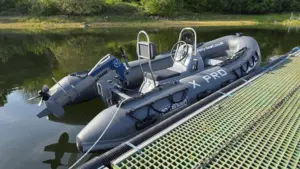
On the other hand, work on a reservoir or lake could involve short bursts and longer periods idling in neutral while clearing banks or undertaking water testing or other research. Do you have to transport heavy equipment?
If you are operating a dedicated safety or standby boat as part of any marine construction or infrastructure repair, then speed to get to a casualty is a key consideration.
How you mainly spend your time on the water is a key factor to determining the power and battery requirements of your motor.
Running it continuously at full throttle will drain down the battery far more quickly than either varying speed or cruising along at 3-4 knots. If you motor along between 5 and 9 knots without planing, then you’ll use a huge amount of power. This is exactly the same whether you’re using electric or petrol as your power source – it’s just a matter of basic physics. Pushing water aside is very energy intensive and the use of power is simply more noticeable with electric motors as batteries are less energy dense.
-
How important are weight and portability?
People often overlook these two factors when it comes to choosing an electric outboard – but they’re really important.
Do you have to carry your outboard from your vehicle to your boat every time you head out?
Would carrying a heavy motor in one piece be easy or would a removable or separate battery make life simpler?
If you’re fitting a permanent installation, portability is less of an issue but the battery location and weight distribution becomes more important to ensure the boat is balanced and performing well.
-
How will you charge the battery?
If your requirement is for a more powerful motor and battery set-up then it’s likely you’ll need access to shore power – so if this isn’t readily available then what options are there for you?
If a smaller, portable motor option suits your needs, you still need to think about how you’ll charge the battery. Can you plug it in back at base or will you need to take it home.
Would a solar charging option be useful?
All of this is less smelly than lugging fuel cans around, but thinking about how you’ll charge the battery(ies) is all part of the planning to save frustration further down the line.
Understand your own use case
The single most important piece of advice that we can give is this: don’t buy someone else’s solution.
Two people or businesses might have the same boat but use it in completely differently ways. Understanding your own specific use case gives you the best starting point and will make your conversations with possible suppliers more productive.
Related Articles
 OTHER NEWS
 FEATURES & VIDEOS
 FEATURES & VIDEOS