

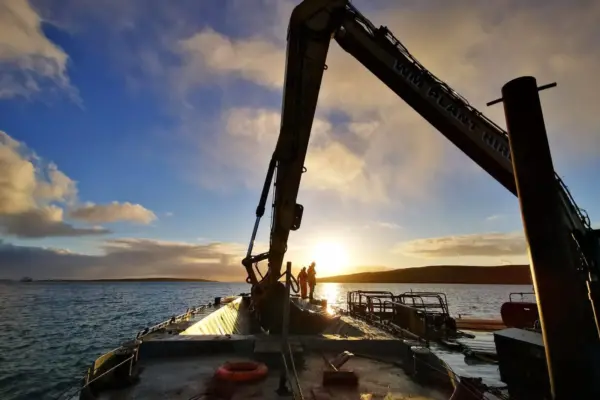
New research phase for Spanish floating wind
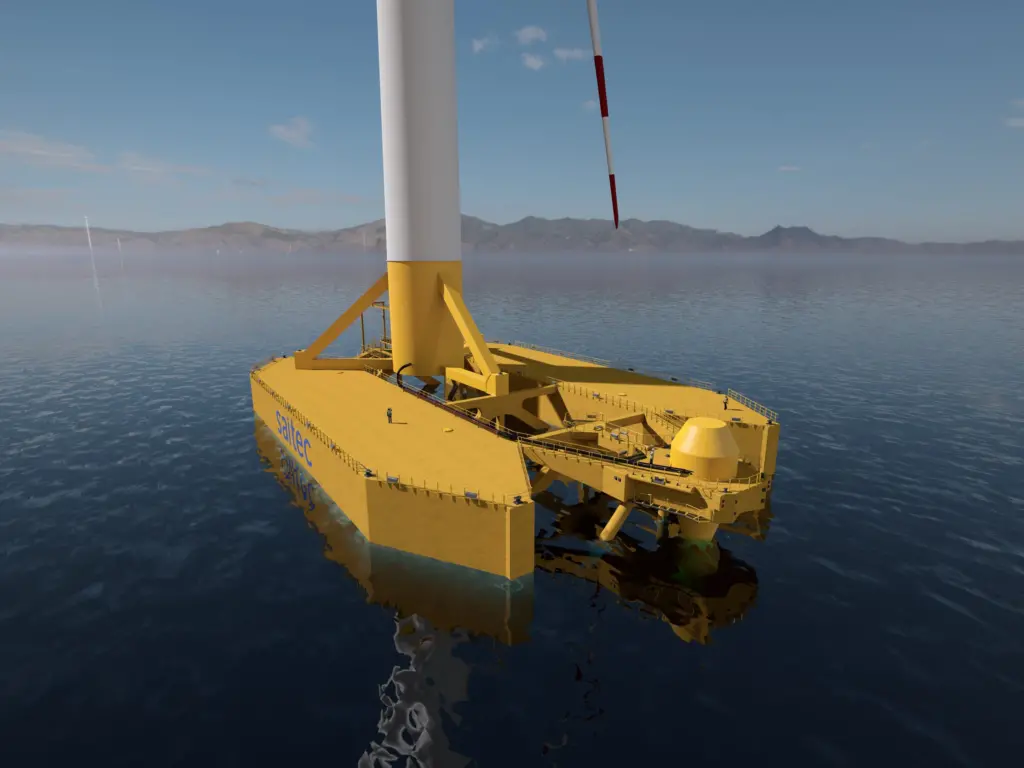
A 2MW Spanish floating offshore wind project will extend its operations with a new Japanese partner to focus on technology optimisation and new construction methods.
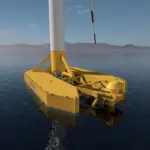
The DemoSATH floating wind project was begun in 2023 at the Biscay Marine Energy Platform (BiMEP) test site off Armintza, in Spain’s Basque Country, where the continental shelf is too deep for fixed-bottom turbines to be installed.
Now Japanese contractor Kumagai Gumi has joined existing partners Saitec Offshore Technologies and Kansai Electric Power Company (KEPCO) to investigate how floating wind technology can be refined and transferred to future commercial-scale developments.
Central to the research is Saitec’s SATH technology, which supports a wind turbine on a concrete, twin-hull floating foundation. Installed about 3.2km offshore in around 85 metres of water, DemoSATH was assembled at the Port of Bilbao and towed to its offshore test location.
The demonstrator became the first floating offshore wind turbine connected to Spain’s electricity grid.
Test conditions
After three years, DemoSATH says the platform has proved its structural, dynamic and operational behaviour in real sea conditions, enduring waves of up to 13 metres and wind gusts reaching 100 km/h.
Its instrumentation and monitoring systems have generated operational data that can be compared with the engineering models used during design, helping researchers improve their understanding of how floating structures respond to offshore conditions.
Kumagai Gumi will contribute construction expertise, concentrating on optimising future decommissioning methods and developing more efficient construction procedures for serial production. The company is also seeking opportunities in the manufacture of concrete floating foundations for the emerging floating wind sector.
Further research will examine monitoring of key system components, data analysis, predictive modelling and the characterisation of platform performance across a range of sea conditions.
By extending operations and bringing construction expertise into the research programme, the partners aim to reduce uncertainty around the design, manufacture, operation and eventual decommissioning of future floating wind farms.
The findings are intended to support larger projects in international markets, where industrialised construction and the use of local supply chains will be important considerations in scaling floating offshore wind.
Related Articles
 DREDGING & FLOOD DEFENCE
 ENVIRONMENT
 FEATURES & VIDEOS