
EXCLUSIVE: IMCA to urge regulators to shelve fuel taxes
Global marine contracting association IMCA has kicked off its annual conference in Antwerp pledging to be the voice of the offshore construction industry.
Launching ‘IMCA 2030’ this morning, IMCA CEO Iain Grainger set out three pillars for the future and told delegates he and other members are in talks with regulators to reconsider their approach to decarbonisation.
“We are going to be paying an operational tax for using fossil fuels but we have no alternatives,” he said. “We are educating the legislators – we can’t end up just paying tax and being unable to do the work because of the lack of available alternatives.
“Our vessel owners are decarbonising their vessels, they are measuring efficiency, having less standby. We can reduce our carbon footprint just by doing things differently and educating our clients.”
With the latest EU ETS penalty due to go in force for vessels above 5,000GT on January 1, operators are facing far higher fuel prices. For vessels above 400GT, operators will have to monitor and record their fuel use from January 1 before the inevitable penalties go in force down the line.
“We’re going to be much more active in Brussels and in the IMO, but in Brussels that ETS is coming down the line,” Grainger told Maritime Journal after the opening.
“The UK ETS is coming in next year as well, and we don’t want another regime coming from the UK ETS that’s different from the EU because that’s going to be confusing. Wouldn’t the UK be better to wait and harmonise them and release them at the same time?
“Norway’s developing its own ETS, which is going to be different from the other two as well. So with the lack of a single IMO global framework, we’re going to have a patchwork of ones that are going to start to become country by country.”
Client push
Benjamin Graff, head of the Nautical Department with Fred. Olsen Wind Carrier, said pressure from clients who wanted to go green was forcing industry to change quickly – and at high cost.
Fred. Olsen has three offshore wind installation vessels – Brave Tern, Bold Tern and Blue Tern – and they all operate on diesel although could be set up with ethanol or methanol were they available.
“Clients and charterers want to be net zero over the next five to 10 years,” he said – yet there was always a conflict because during operations it was impossible even to slow steam because of contractual obligations.
“Even when we know we need to slow down to catch a tide we have to go full speed anyway otherwise we are penalised,” he said.
“Everything is coming from the IMO and the EU. We need a strong voice explaining to them that everyone wants to be clean but only if it compares with diesel fuel.”
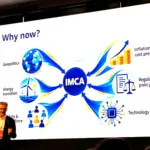
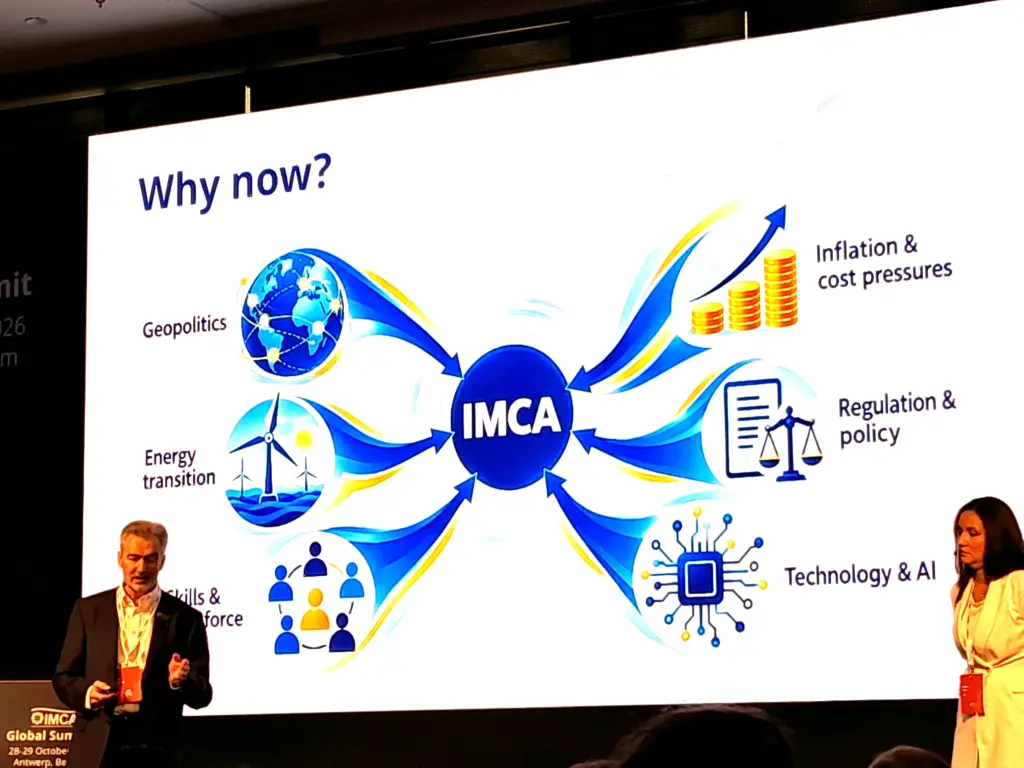
And this is where the new IMCA 2030 is setting itself up – as a voice needed by an industry facing so many issues – geopolitical upheaval, inflation, AI, the energy transition and skills shortages and regulations like these.
“This is why we’re strengthening our voice,” said Grainger. “Wherever our members have got challenges that we can be a stronger voice on, whether it’s a safety challenge, whether it’s a taxation challenge or a local content challenge, we can go and be their voice.
 “It’s not just with the EU and the IMO – we are lobbying on the challenges of getting work visas for vessels, for example.”
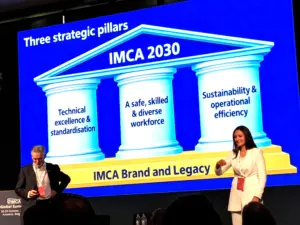
Opening the event, in a conference centre in the grounds of Antwerp’s zoo, former BBC business anchor Susannah Streeter set out the three ‘IMCA 2030’ pillars:
- Advocating for technical excellence and standardisation
- Championing a safe, skilled and diverse workforce
- Supporting sustainability and operation efficiency
For more coming out of the IMCA 2026 summit, watch this space.