![MaritimeJournal[Seawork]](https://www.maritimejournal.com/wp-content/uploads/2026/09/MaritimeJournalSeawork.svg)
“Making stressful situations calm”: Volvo Penta’s approach to assisted docking
Volvo Penta’s IPS Professional Platform combines assisted docking with intelligent power management. Aboard the Penta 40, Isabelle Bylett experiences what the system could mean for the crew workload and operating efficiency of commercial operations.
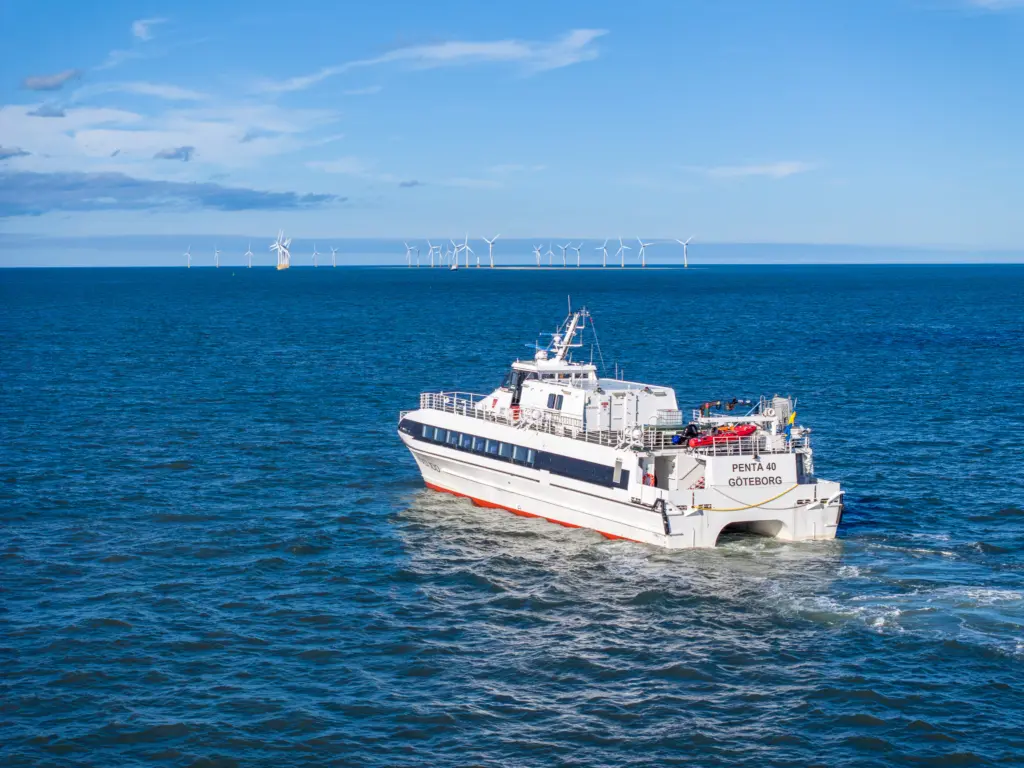
Maritime Journal took to the open water with Volvo Penta for an hour-long sea trial of its latest IPS Professional Platform last week.
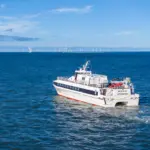
Setting sail from Great Yarmouth, Norfolk, guests took the controls of the 38m Penta 40, a former Norwegian passenger ferry used by Volvo Penta as a test and demonstration vessel, to see how the latest evolution of the almost iconic IPS system, ‘our fully integrated helm-to-propeller experience’, worked in practice.
Combining propulsion, electronic controls and intelligent power management, the platform now ventures into larger commercial vessels and superyachts.
First introduced in 2005, IPS was developed as an alternative to conventional inboard shaft propulsion, offering benefits including improved manoeuvrability and fuel efficiency. The Professional Platform extends the system into larger vessel applications, with Volvo Penta citing a target range of 25–55 metres and above.
Far beyond ease of handling, the integrated IPS system raises wider questions for commercial operators: how can improved manoeuvrability affect day-to-day operations, and what difference can it make to fuel consumption and running costs?
Making manoeuvring more manageable
One of the clearest demonstrations of the IPS Professional Platform’s capabilities was revealed during a docking manoeuvre. The joystick controls on the starboard and port sides of the deck make small, measured adjustments easier, with the vessel settling between each movement rather than constant adjustments having to be made to account for wind and tide.
Despite the low tide and strong current, the bow stayed steady. The experience highlighted how assisted docking could make close-quarters manoeuvring more manageable, particularly in challenging conditions or confined spaces.
Kajsa Mentes, senior test engineer onboard, said the aim was ‘to make stressful situations feel calm’. By helping the vessel maintain its position during a manoeuvre, the system gives crew more confidence when approaching a berth and preparing to moor. In a single-handed operation this could be particularly useful, potentially allowing the operator to bring the vessel alongside before attending to mooring lines and fenders.
All visitors were given the opportunity to independently try out the docking, with the crew demonstrating complete confidence in the system’s capabilities. Even a complete beginner like myself was put as ease, especially when Mentes said a 10-year-old family member had managed to safely and effectively dock the vessel.
The system’s steering angle of up to 40° and dual power input design allows for an efficient management of power. The hydraulic clutch in the upper gear controls propeller speeds down to 20 rpm, and the design gives smooth assisted docking, even in larger commercial vessels.
Unlike a conventional arrangement that may rely on a separate bow thruster for certain manoeuvres, IPS uses its propulsion drives to direct thrust. The forward-facing DuoProp propellers aid assisted docking and tight manoeuvrability.
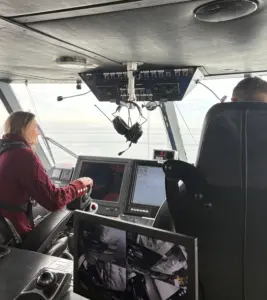
Image Credit: Volvo Penta
The Penta 40 had originally been powered by a controllable pitch propeller (CPP) system with 2880kW of total power. Technical Sales and Application Engineer James McPaul said the new IPS system meant the vessel could reach a service speed of 31 knots in 28 seconds instead of 50. The upgrade also delivered reported savings of 2,000kg in weight and improvements in fuel consumption.
During the sea trial, with the Penta 40 accelerated smoothly, remaining stable even at higher speed. From a first-time driver’s perspective, the vessel’s responsive handling made the Penta 40 easy to steer, with the joystick controls feeling controlled and straightforward to handle.
EcoMode: matching power to demand
Alongside manoeuvrability, the IPS Professional Platform is designed to improve operating efficiency through its EcoMode feature. The system can automatically start and stop individual engines according to the power required in a given situation, rather than keeping every engine running throughout an entire voyage.
That approach reflects the way many commercial vessels operate. Volvo Penta cites logged data from 473 vessels powered by its D13–IPS1350 systems, covering a combined 846,200 operating hours. Volvo Penta says users spend around half their operating time at lower speeds, when half of the engines are sufficient to power the vessel. EcoMode is designed to take advantage of those periods, reducing unnecessary engine use while retaining power when demand increases.
By optimising engine running hours, the system can lengthen intervals between servicing and maintenance, potentially reducing operating costs over the vessel’s working life.
Volvo Penta illustrates the potential savings with a case study based on a customer vessel operating along Italy’s Amalfi coast for about 2,000 hours a year, between March and October. Using operating-cycle data from that vessel alongside data from its Norwegian test ferry, the company modelled an estimated 22% reduction in fuel consumption, equivalent to 71 cubic metres of fuel and 190 tonnes of CO₂ a year.
The system is also designed to work across different power configurations, including diesel, hybrid and electric. In a hybrid installation, the same principle of matching power to demand is applied across the available power sources.
Mentes says this helps to ‘equalise’ their use, rather than relying disproportionately on one power source. By managing when individual engines or power sources are used, the system aims to optimise efficiency while balancing operating hours.
Balancing performance and efficiency
For Volvo Penta, the platform’s value lies in bringing these functions together within a single system.
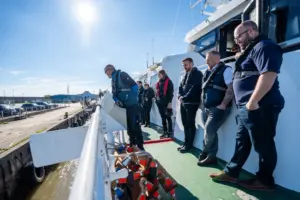
Image Credit: Volvo Penta
“The IPS Professional Platform brings the propulsion, driveline, steering and controls together as one integrated system, rather than separate components,” said Mehmet Belibagli, director Marine Sales Europe West at Volvo Penta UK & Ireland. “The forward-facing IPS system gives operators very responsive handling and precise manoeuvring, and features like Eco Mode and dynamic positioning reduce fuel use and make docking and station keeping easier.”
Belibagli said the platform is designed with redundancy in mind to support vessel availability and is prepared for hybrid and electrified configurations as customer requirements evolve.
The combustion-engine version of the IPS Professional Platform was introduced in 2025, with hybrid and electric versions listed for 2027 and 2028. For commercial operators, the appeal lies in combining precise vessel handling with the potential to improve fuel efficiency and manage operating costs over a vessel’s working life.