



Europort opens with AI-written keynote speech
The 41st Europort shipping exhibition and conference was opened with a sign of the times – a keynote speech that had been created entirely by artificial intelligence.
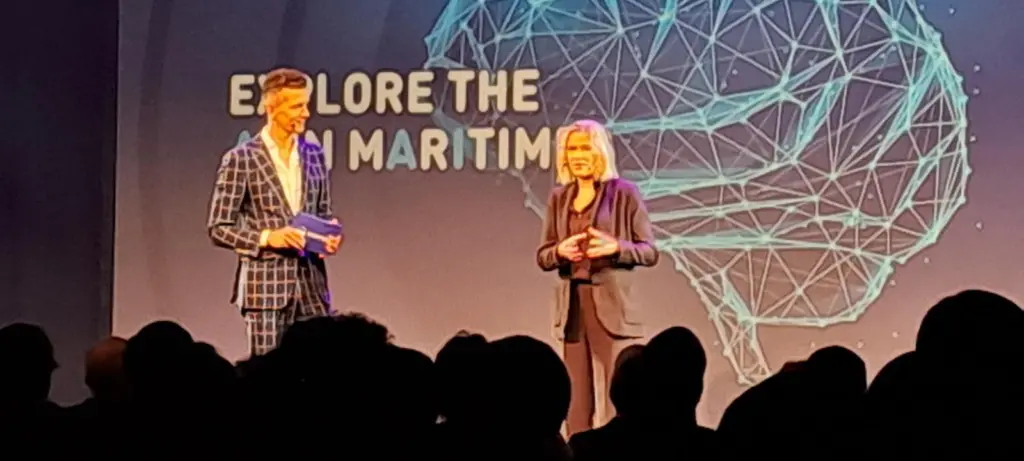
“We approached Richard Branson,” said host Geert Maarse. “And he was available – but we didn’t have the $500k budget.”
Instead of Branson, attendees in the auditorium, a new addition to Rotterdam Ahoy, were played a film introduced by physical man Luc Laurent (we found out soon afterwards that this was not his real name) that had been conjured up by AI and bore little reality to the truth.
This writer was probably not the only one scratching her head about the reasons for this opening, but if nothing else it led the way to an opening debate about artificial intelligence in shipping: its benefits, its risks and its challenges.
One of the main benefits was in how it could be used to make predictions, for instance with maintenance and route optimisation, and therefore cut costs. And all the panellists were insistent that it would only be beneficial if it were used in tandem with, and not in place of, human beings.
The panel consisted of four: Ilyaz Nasrullah, digital strategist with SMASH!; WISTA president Elpi Petraki, also business development manager at ENEA Management Inc; Kongsberg Digital president and CEO Shane McArdle; and Sander Haas, Head of Business Engineering & Transformation with logistics giant Samskip.
On the spot
The panellists were asked if they expected artificial intelligence to dominate the maritime industry within five years.
Where Kongsberg’s Shane McArdle instantly replied ‘yes!’ the others were more circumspect.
“I don’t think it will dominate but I do think we have very rapid development,” said Petraki. “It’s not like technical innovation, it’s digital innovation; but we are not ready to accept it because of the risks that we don’t understand yet.”
McArdle later added that AI could not be ignored or the industry would be passed by.
“We need to embrace it to make our future safer,” said Petraki – to which Haas replied: “It’s the leadership in the companies and government bodies that need to embrace it first, see the possibilities, new people, new ways of working and understanding can do.”
Ilyaz Nasrullah ended the section by saying AI wasn’t a new revolution, merely an expansion of what computers were already doing. And it was important, he said, not to embrace this technology with misinformation or ‘you will invest in stuff that doesn’t work’.
Inequality
One of the challenges that faced smaller companies in the industry was the cost of artificial intelligence and the likelihood that it would leave them behind.
“Only companies that are big and have large data can jump on this train,” said Nasrullah. “Smaller companies, many of them still work with paper, so this would be a massive leap. There are no possibilities for the smaller companies to keep up.”
McArdle agreed. “We need to put responsibility and accountability on the companies doing it, we need national and international governments to regulate so we don’t stifle competition,” he said.
Officially opening Europort after the panel discussions, Rotterdam Ahoy CEO Jolanda Johansen had the final word on artificial intelligence. For now, at least:
“It’s a big honour for us, in the new part of the convention centre – having people here building on shared ambitions and experiences,” she said. “We talk about AI but we really believe in the power of life.”
Related Articles
 OTHER NEWS
 SPONSOREDSTORY
 INDUSTRY NEWS