

Dutch lay early groundwork for German LNG job
A Dutch shipyard is already gearing up for the LNG conversion next year of a second RoPax ferry belonging to German owners AG Ems, writes Tom Todd.
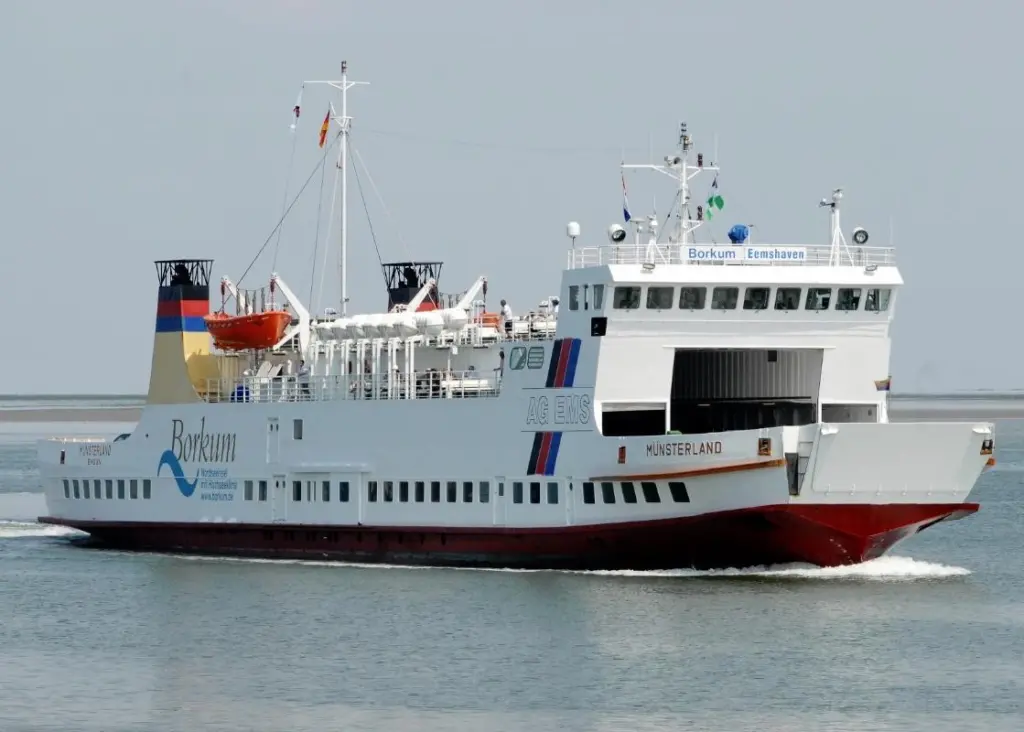
While the ship in question – the 78.83m RoPax ferry Münsterland – remains in German island service, construction of its new 15m x 12.6m stern is getting underway at Koninklijke Niestern Sander, said AG Ems spokeswoman Corinna Habben. She also told Maritime Journal LNG components for the conversion were now also being assembled.
Explaining that AG Ems wanted Münsterland kept in Bight service during the upcoming 2020 season Habben also said: “We do not want to run the risk of possible delays (as happened with Ostfriesland), so the ship will not leave service until September 2020. This means that the conversion period is clearly defined – delivery will then be in February of 2021”.
The mention of Ostfriesland refers to delays and lost service time when the almost identical AG Ems ship underwent similar pioneering LNG conversion at Bremen’s BVT in 2015. That ground-breaking job was the first LNG conversion of a serving German flag ship. In the same year AG Ems chalked up another first with Germany’s first LNG-driven newbuilding, the Fassmer-built 83m Helgoland.
Munsterland, built in1986 at the Martin Janssen Schiffswerft, will be some 34 years old when it sails to Niestern Sander next year for conversion costing €17.5 million. It will do so using its current two Wärtsilä 8R 22 MD engines.
It’s new stern will not only house Münsterland’s new LNG tank and propulsion system. It will also provide the ship, which carries 1200 passengers and 55 cars, with room for 15 more cars, two new public areas and a bigger sun deck. Ship length will increase to around 93.8m.
After conversion, and like Ostfriesland and Helgoland, Münsterland will boast two Wärtsilä 6 L 20 DF main engines each of 1065kWe and Wärtsilä LNGPacs. Also on board will be a Scania-based 232kW auxiliary for onboard power.
The converted ship will also have two Veth azimuthing VL-1250i-CR pod drives with counter-rotating four blade (front) and five blade (aft) propellers and a Veth Jet 2-K-1300 422kW bow thruster.
The conversion is getting funding from the German Government, the local federal state and the EU’s European Regional Development Fund.
Related Articles
 OTHER NEWS
 MARINE RENEWABLES
 ACCESSORIES & EQUIPMENT